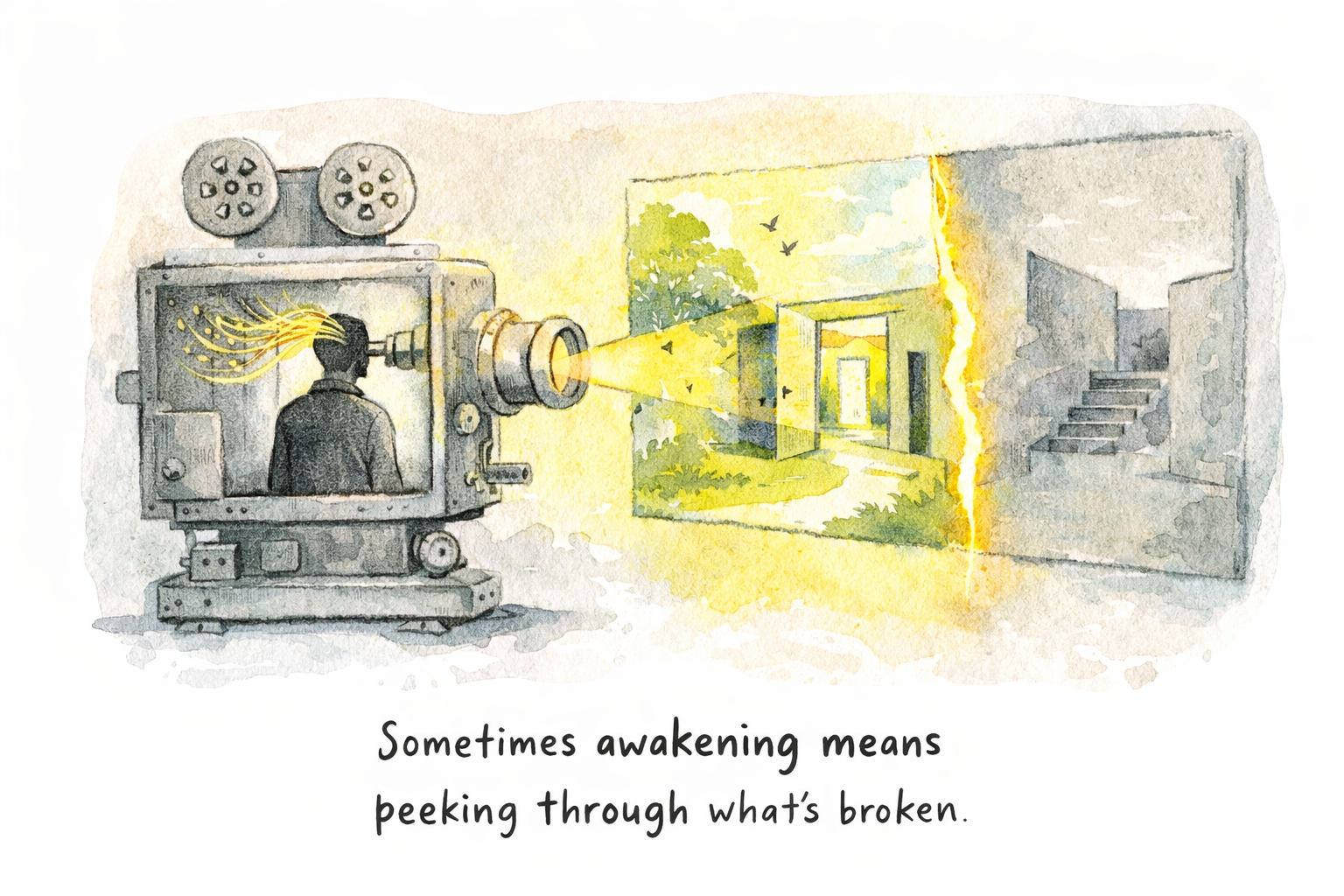
I bumped into a woman last year who was genuinely convinced she was cursed. She wasn’t making a scene; she told me this with the sort of flat, matter-of-fact tone you’d use to describe the weather. That made it harder to brush off.
When someone is hysterical, you can blame the mood. When they’re calm, you start to wonder if they’ve actually found a fundamental truth.
But then I watched her live.
Someone offered her a life-changing introduction, and she just… let it go.
An idea landed in her lap that could have solved her biggest problem, and she set it down and forgot it by lunch.
She wasn’t lacking talent. She was missing the signals.
Our brains take in millions of bits of data every second, but we only actually “see” a tiny fraction of it. The rest gets tossed. Your brain isn’t choosing what to keep at random; it’s looking for what you’ve told it is important.
If you tell your brain you’re unlucky, it becomes an expert at finding the exits and ignoring the doors.
The world you see is just the world your brain was trained to find.
Complaining is a Workout (For the Wrong Muscles)
Complaining is basically a gym membership for misery. Every time you air a grievance without any plan to change it—no action, just the words—you’re doing a rep. You’re making that neural pathway thicker. After enough time, your brain becomes a high-speed rail for finding what’s wrong.
The person doing this ends up living in a worse world than the person next to them. Not because their car broke down or their boss is a jerk, but because their internal radar is now tuned strictly to the frequency of this sucks.
To break the loop, you have to end the thought somewhere, even if it’s an awkward, messy conclusion.
Never leave a complaint “open.” Close the circuit or change the channel.
Discipline is a Trust Exercise
Most of us treat discipline like a boxing match against ourselves. We think we have to beat our “lazy” side into submission. That framing burns everyone out.
Biologically, discipline is your brain learning if it can believe you.
When you do the thing you said you’d do, your nervous system relaxes. When you bail, your brain starts running a “we’ll see” background program. It creates a restlessness that follows you into the room.
Your vibe is a physical trail. We actually leave chemical traces of our internal state in the air. If you’re running on self-doubt and high-alert stress, strangers can feel it.
On the flip side, giving yourself a mental high-five while you’re working actually moves the needle. Telling yourself “I’m actually crushing this” mid-task spikes your dopamine. It turns out that belief predicts performance better than talent. You have more authorship over that internal state than you think.
Why Obsessed People See More
Ever notice how when you want a specific car, you suddenly see it on every block? That’s your Reticular Activating System (RAS). It’s the bouncer in your brainstem.
When you get obsessed with a project, you aren’t just “working harder.” You’re training that bouncer to let different information into the club.
- You notice the one person in a crowded room who has the missing piece of your puzzle.
- You see opportunities that other people walk past because their bouncer wasn’t told to look for them.
“Going all-in” isn’t about the hustle; it’s about re-calibrating your filter. You don’t get what you want; you get what you look for.
The Hidden Price of “Easy”
There’s a study from MIT about people using AI to write. The folks who let the machine do the heavy lifting showed a measurable drop in critical thinking.
When you have to search for info, read three different articles, and weigh them against each other, that friction is where the magic happens. Take away the friction, and you get the answer faster, but you get dumber in the process.
It’s the same with the lost art of talking to yourself. Thinking out loud while you’re driving or walking builds an internal intuition. When we outsource that to a screen, the muscle atrophies. You get faster and less calibrated at the same time.
The Bottom Line
The brain you’re walking around with today was built by everything you’ve repeated and felt up until now. You didn’t have much say in the early chapters, but you’re the one holding the pen now.
The only thing worth asking is: What am I training my eyes to find today?
Leave a Reply