Bessel van der Kolk’s work broke something open for me – mostly the illusion that understanding my wounds was the same as healing them.
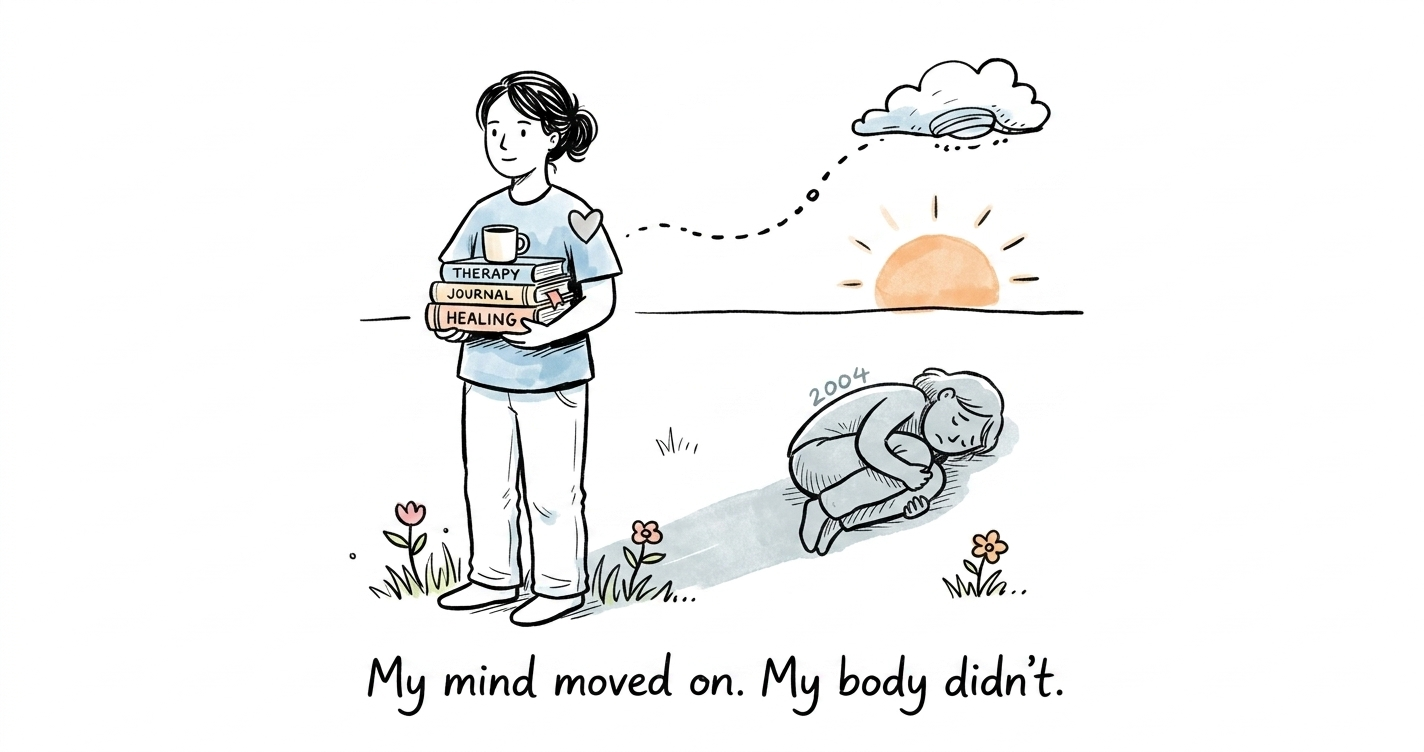
I can tell you exactly why I flinch when someone raises their voice. I can trace it back to a bedroom wall and a pillow over my head and two adults who should have taken it outside. I can name the attachment style it created, the coping mechanisms it installed, the way it shows up in my relationships two decades later.
I’ve done the reading, the journaling, the therapy homework. If understanding were medicine, I’d be cured by now.
My jaw still clenches at night. My stomach still drops when someone I care about goes quiet on me.
I still reach for a notebook and start planning obsessively the moment anxiety kicks in — filling pages with time blocks that look beautiful and collapse before dinner because
The planning was never about productivity, it was about finding the one thing I could control when nothing else would cooperate.
I understand all of this. Completely. It hasn’t changed a damn thing in my body.
And apparently, according to Bessel van der Kolk — the psychiatrist who wrote The Body Keeps the Score, a book that’s been on the bestseller list for seven years — that’s exactly how it’s supposed to work.¹ Or rather, how it’s supposed to not work.
Because understanding and healing, it turns out, are two different biological events that happen in two different parts of your brain — and the part that does the healing doesn’t speak English. It speaks in stomach knots and shallow breathing and muscles that brace at two AM for a danger that left the building in 2004.
“The rational brain is basically impotent to talk the emotional brain out of its own reality.” — Van der Kolk, The Body Keeps the Score
Impotent. A professor of psychiatry at Boston University chose that word to describe the thing most of us rely on — insight, self-awareness, “doing the work” — when it comes to actually changing how our body responds to the world.
The thinking brain sends a perfectly worded memo: “We’re safe now. The war is over. Please stand down.”
And the survival brain doesn’t even open the email.
The Burnt Toast Problem
Think about the smoke detector in your kitchen for a second. It has one job: detect particles in the air and scream.
It does this job whether the particles are coming from a house fire or a piece of sourdough that got away from you. It can’t tell the difference. It doesn’t have an opinion about context.
Smoke is smoke, and smoke means scream.
Your brain has a biological smoke detector — the amygdala — and if you grew up in an environment where safety was inconsistent, your detector got calibrated during a crisis.²
The crisis ended, maybe years ago, maybe decades ago. The calibration didn’t update. So now your boss says “hey, can we chat for a minute?” and your hands go cold before your conscious mind has time to think “this is probably about the project timeline.”
Your partner closes a door with slightly too much force and something in your chest locks shut.
A friend doesn’t reply for a day and your gut starts composing eulogies for the relationship.
The thinking brain catches up eventually — evaluates, contextualizes, correctly concludes that this is burnt toast, not a fire.
But by then the smoke detector has already flooded your bloodstream with cortisol, locked your muscles, shifted your breathing into that shallow, chest-only mode that makes you feel like you’re about to give a presentation at gunpoint.
The body committed to its conclusion before the mind even got a vote.
I work in tech recruiting, and there’s a concept in software called a race condition — two processes trying to use the same resource at the same time, and the system crashes because it can’t decide which instruction to follow.
That’s what’s happening every time your thinking brain says safe and your survival brain says run simultaneously.
The system crashes — as anxiety, as rage, as that frozen blankness where you can’t speak or think and just have to ride it out.
The worst of it: the crash gets saved to memory. In the body.
On hardware you can’t access through conversation. You can talk about it in therapy until you’re hoarse. The firmware doesn’t update through the microphone.
The Map That Was Drawn Before You Could Spell Your Own Name
Van der Kolk describes the brain as a “use-dependent organ” — it physically wires itself based on what it experiences, and the wiring that happens earliest becomes the deepest foundation.³ I keep thinking about this like city infrastructure. The first roads in any city were designed for horse carts, but a hundred years later, when the city is full of electric cars and metro lines, those original roads are still there underneath everything. And under pressure — rush hour, a storm, an emergency — traffic finds its way back to them every time, because they’re deeper, more worn, and the tires follow them without thinking.
If the people raising you were warm and consistent, your deepest road says the world is mostly safe and people mostly show up. If they were volatile, or absent, or overwhelmed, your deepest road says something else. And you were two years old when it was paved, which means you had the same ability to review the construction plans as you had to file your own taxes — exactly none.
“Being able to feel safe with other people is probably the single most important aspect of mental health.” — Van der Kolk, The Body Keeps the Score (p. 81)
A friend of mine — sharp, successful, the kind of person who lights up a room — deflects every compliment like she’s returning a serve. Her boss praises her and she spends the rest of the day bracing for the correction that must be coming. She told me once, couple of drinks in, that she always feels like she’s faking and eventually everyone will figure it out.
She knows where this comes from. Her mother told her, regularly, from as far back as she can remember, that she was difficult. Too much. Exhausting. She can explain the psychology of this with the fluency of someone who’s read twelve books on the subject and done three years of therapy.
She still white-knuckles her coffee mug every time someone tells her she’s doing a good job. Because knowing which road you’re on doesn’t reroute the traffic. The rerouting has to happen in a layer of the brain that only responds to felt experience — sensation, movement, breath, touch. Language doesn’t reach it. Insight doesn’t reach it. One of van der Kolk’s patients put this better than any clinician could: *”I spent my adulthood trying to let go of my past, and the irony is I had to get closer to it in order to let it go.”*⁴
Closer to it. Through the body. Which is the opposite of what most of us try to do, which is understand it from a safe distance and hope the distance is enough.
It’s not.
Every Weird Thing You Do Was Genius Once
In ecology, there’s a concept called adaptive mismatch — a trait that evolved perfectly for one environment becomes a problem when the environment changes. A camel in the Sahara is a masterpiece of engineering. A camel in a swimming pool is drowning slowly while still trying to conserve water.
Van der Kolk’s work is, at its core, a long and meticulous catalog of human camels in swimming pools. Every behavior that looks baffling from the outside — the addiction, the emotional shutdowns, the need to control everything, the self-sabotage — all of it began as a strategy that worked perfectly in the environment where it was invented.⁵
A woman in his practice lost 150 pounds through a weight loss program and gained almost all of it back within three months. When her doctor asked what happened, she said that after losing the weight, a male coworker told her she looked attractive, and she started eating that same night. Because she’d been sexually abused as a child, and she’d figured out — without ever consciously deciding to — that being invisible to men was the only reliable form of safety she’d ever had. “Overweight is overlooked,” she told him. The weight was a wall between her and the thing she feared most, and a well-meaning doctor demolished it without understanding what it was holding back.
I think about my own planning compulsion through this lens and it makes a painful amount of sense. When I was a kid and the adults in my house were unpredictable, the notebook was the one thing that behaved consistently. I wrote the plan, the plan obeyed me, and for thirty minutes the world felt orderly. Brilliant strategy at twelve. At thirty-nine, the same strategy eats half my day and produces nothing except the temporary calm of feeling like I have a grip on something. The camel is still conserving water. The desert ended twenty years ago.
“Every person tries to have the best possible life they can.” — Van der Kolk
That sentence sounds like something you’d find on a coffee mug until you apply it to the woman with the 150 pounds, or the teenager who cuts because a razor blade produces the only predictable sensation in an unpredictable life, or the veteran who drinks because alcohol is the one substance that turns the smoke detector off long enough to sleep. Apply it to them and it becomes the most generous thing a clinician has ever said about human behavior. Apply it to yourself — to the thing you do that you can’t explain and can’t stop — and it becomes something else entirely. Something that looks a lot like the beginning of self-compassion.
The Treatments That Sound Ridiculous (And Why They’re the Only Ones That Work)
Van der Kolk tested Prozac and Zoloft for PTSD before anyone else did.⁶ The drugs barely moved anything. He published the data. The psychiatric establishment praised his work and kept prescribing the drugs. The VA spent billions.
So he looked at what his colleagues considered embarrassing. And it worked better than anything in the medicine cabinet.
Yoga outperformed every drug.⁷ The reasoning is simple once you hear it: trauma teaches your body that sensation equals danger, so over time you go numb — you shut off the wires that carry pain, but pleasure and aliveness travel the same wires. You can’t selectively numb. Yoga teaches the nervous system, slowly, that feeling something in your body doesn’t have to mean something terrible is coming.
EMDR — recalling a trauma while following someone’s fingers with your eyes — sounded absurd to van der Kolk when his colleagues started doing it.⁸ Then he watched people who’d been locked inside their worst memories for decades say, with a calm they’d never had: “That happened to me, and it was a long time ago.” Brain imaging showed the eye movements physically rewire three major neural networks.
Theater. Shakespeare programs for juvenile offenders. A teenager who’s only known violence plays a king on stage, and his body learns what authority feels like without a fist behind it.⁹ Talk therapy describes mango. Theater is the bite.
Van der Kolk watched Desmond Tutu work with communities in South Africa that had been through collective violence — and before anyone spoke about their trauma, Tutu had the room pray together, sing together, dance together.¹⁰ He created rhythm and safety in the body first. Then the words came. The body before the story. The felt sense of “I’m okay right now” before the narrative of “I wasn’t okay back then.”
Every treatment that actually heals goes through the body, because that’s where the wound is stored. Talking to the thinking brain about a survival-brain wound is like writing a letter to someone who can’t read. The letter might be beautifully composed. The delivery method is wrong.
What Actually Changed
I went into van der Kolk’s work thinking I was going to learn about other people — soldiers, abuse survivors, people with clinical diagnoses I couldn’t relate to. Somewhere along the way the lens flipped and I was looking at myself.
The planning compulsion. The jaw clenching. The flinch at a raised voice that hasn’t faded a single degree in twenty years despite my understanding exactly — precisely, articulately, eloquently — where it came from. All of it running on the same engine: a body with its own memory, its own timeline, its own logic that has nothing to do with what the calendar says or what my therapist helped me understand last Tuesday.
“The only way we can change the way we feel is by becoming aware of our inner experience and learning to befriend what is going inside ourselves.” — Van der Kolk
Befriend. He uses that word a lot, and it sounds soft until you realize what it actually means — feeling the thing you’ve been spending years organizing your entire life around not feeling. Sitting with the sensation in your chest without converting it into a journal entry or a plan or an insight. Letting the body speak in its own language, which is uncomfortable and wordless and has none of the satisfying click that understanding provides.
My therapist told me years ago that I can’t think my way out. She was right.
Thinking was the map. Healing is the walking. I’d been sitting in a chair with the map spread across my lap, studying every contour, tracing every route, congratulating myself on how well I understood the terrain — while my boots sat by the door, untouched.
It’s 2026. My body is still stuck in 2004. But for the first time, I’m lacing up the boots instead of redrawing the map. That might not sound like much. But if you’ve been sitting in the same chair I have, you know it’s everything.
Citations
- The Body Keeps the Score — 376 weeks on NYT bestseller list, Jan 2026. Wikipedia
- Van der Kolk (2014). The Body Keeps the Score. Penguin, p. 64.
- Perry, B.D. et al. (1995). Infant Mental Health Journal, 16(4).
- Van der Kolk (2014). The Body Keeps the Score. Patient quote.
- Van der Kolk (2014). The Body Keeps the Score, p. 205. / Big Think interview.
- Van der Kolk et al. (1994). J Clinical Psychiatry, 55(12).
- Van der Kolk et al. (2014). J Clinical Psychiatry, 75(6).
- Van der Kolk et al. (2007). J Clinical Psychiatry, 68(1).
- Van der Kolk, Big Think interview.
- Van der Kolk, DailyGood interview — Desmond Tutu / Truth and Reconciliation Commission.
If anything here sat heavy — talk to someone you trust. You don’t need to have it sorted first.
Leave a Reply