Software engineers have this practice when something breaks—and something always breaks—where they refuse to fix the visible problem until they’ve found the invisible one. The smoke alarm went off, sure, but where’s the fire?
It sounds obvious when you say it out loud. In real life, most of us just yank the battery out and go back to sleep.
We are spectacular at treating symptoms.
Someone who can’t stop overspending gets a budgeting app.
Someone who blows up every relationship reads a book on communication.
Someone who hasn’t finished a project in three years buys a new productivity system.
And look, sometimes those things help. But more often they’re just elaborate ways of being very busy while the actual problem sits in the corner, completely unbothered.
The self-help world figured this out eventually. The whole “trace it back to your childhood” movement—
find the wound, name it, understand where the pattern came from — that was genuinely useful.
A lot of people walked out of therapy finally understanding – why they flinch when someone raises their voice, or why they work themselves into the ground trying to earn approval they never feel like they’ve received.
Understanding that is real. It matters.
The problem is what happens next, which is usually nothing.
People find the origin story and treat it like the destination. They spend years becoming experts on their own damage — incredibly articulate, deeply self-aware, completely stuck. The insight becomes the identity.
I’m this way because of that thing.
Accurate, probably. Also, increasingly useless after a certain point.
There’s a difference between something being real and something being true. These feel like the same thing but they’re not, and the gap between them is where most people lose years of their lives.
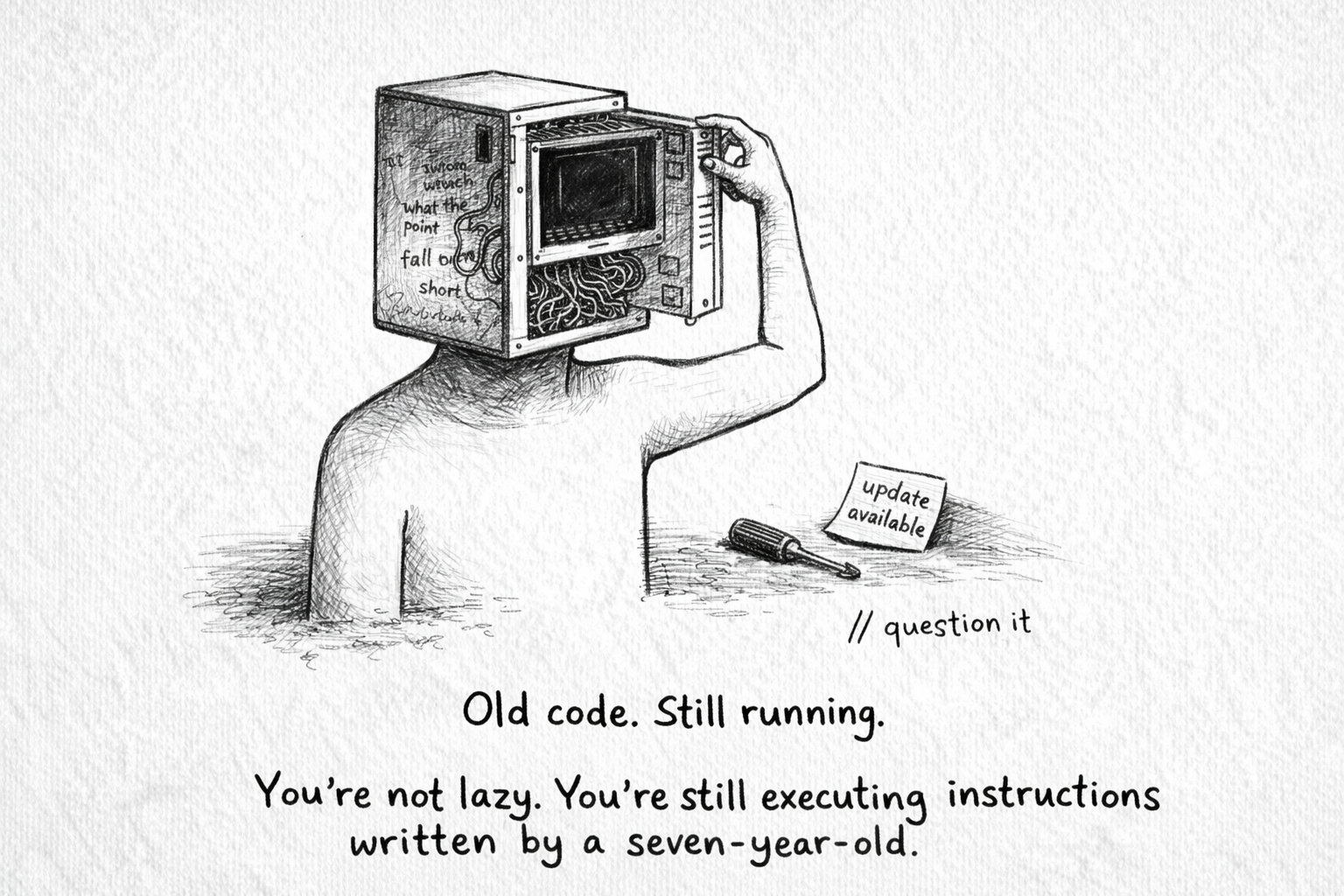
Say someone grew up being told they were the difficult one. Too much. And they believed it, because at seven years old, you take adults completely at their word. That belief then quietly shapes the next thirty years —
how they show up in relationships,
how much space they allow themselves to take up,
how they interpret every piece of feedback they ever receive.
The belief is doing enormous amounts of work in the background.
But is it true?
Was that child actually too much, or were they just too much for that particular set of exhausted, limited adults in that particular household?
The grape doesn’t change. The soil does.
A Pinot Noir grown in Burgundy tastes completely different from the same grape grown in California. Same DNA, wildly different expression depending on what surrounded it during those formative years.
We work the same way.
A lot of what we call personality is adaptation — the flavor we developed in response to the conditions we grew up inside.
Which means it’s adjustable. It’s what we became in a specific environment, and environments change.
Laziness is a good example because everyone either knows someone like this or has been this person at some point. The one with seventeen half-finished projects and a graveyard of good intentions, who can’t seem to generate momentum on anything.
Underneath that, almost always, there’s something like
what’s the point or I’ll probably fall short anyway or people like me don’t really get to have the things they want.
That belief gets so old and so familiar that it stops feeling like a belief. It feels like weather. And you don’t argue with weather, you just dress accordingly and lower your expectations.
But what if you did argue with it? What if you held it up to the light and actually asked — is this an absolute truth?
Cross-examine it the way a lawyer would, looking for inconsistencies.
Because when people do this seriously, the belief almost always falls apart under pressure.
It was constructed from a handful of experiences, filtered through the understanding of a child who lacked the context to interpret them accurately.
It’s been making decisions on your behalf ever since, based on data that was always incomplete.
The belief was never load-bearing. It just got treated like it was.
Finding the belief is actually the easier part — once you start paying attention, it tends to surface fast.
The harder part is that it has felt like the floor for so long that questioning it feels almost disorienting, like suddenly doubting gravity.
But floors can be wrong. And a belief that was handed to you by someone who was themselves confused, overwhelmed, or just not paying close enough attention — that was never yours to keep.
It was always just borrowed furniture in a house you’ve been redecorating around it for years.
At some point the more useful question stops being why am I like this and becomes
is this actually who I am, or just who I learned to be?
Those two things have felt identical for so long that most people never think to check. The ones who do check, though — something opens up for them that all the self-awareness in the world never quite managed to unlock.
Loved every minute of this profound piece of writing, super proud of you Vasu..
Thanks, bhaiya.