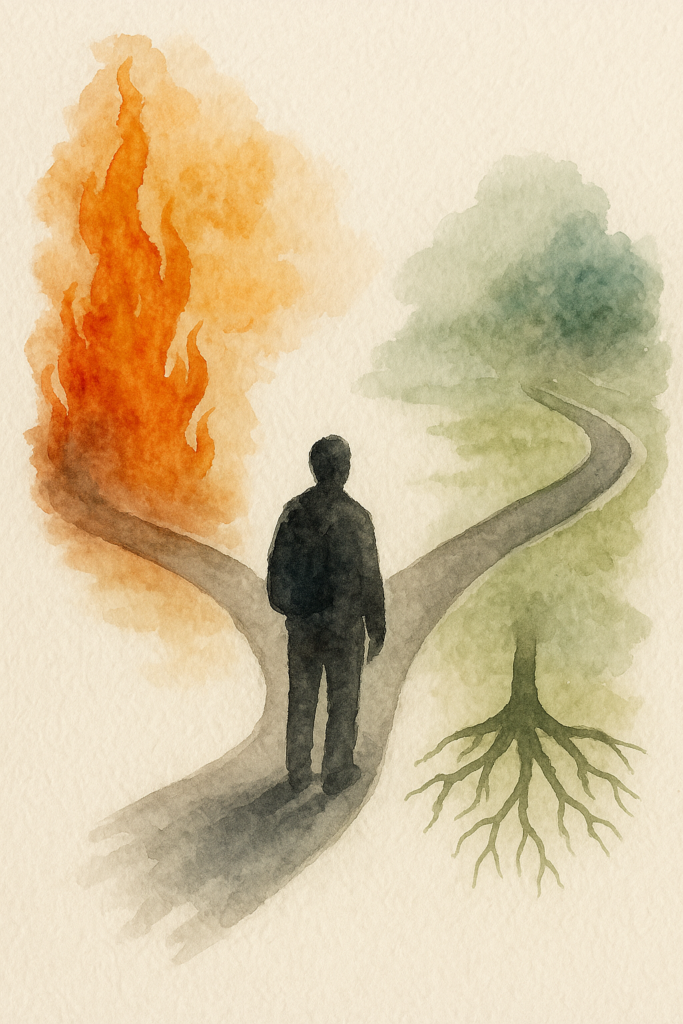
Both look like passion—until you count the cost.
Some people call it drive. Others call it madness. Most of us don’t know the difference until we’ve lost something important to both.
On one end of the spectrum, there’s the romanticized version:
the builder who works 16-hour days,
the mountaineer who refuses oxygen,
the parent who sacrifices everything for their child,
the artist who forgets to eat.
These stories get told at dinner tables and on LinkedIn posts with swelling pride.
Look at how far they went. Look at what they gave up.
But then there’s the quieter version. The part we don’t talk about.
The founder who can’t sleep unless she’s checking metrics at midnight.
The climber who misses his daughter’s first birthday because the weather window opened.
The lover who rearranges her entire life around someone who barely notices.
The student who ties their entire self-worth to the next gold star.
They all start with passion. They end, too often, in loneliness, injury, or some deep identity crisis disguised as “a pivot.”
And yet, we glorify the chase. We worship obsession. We feed kids stories of people who wanted it more, sacrificed it all, stayed hungry, stayed foolish—without ever pausing to ask: At what cost?
Obsession has brilliant PR. It looks like discipline. It sounds like clarity. But scratch the surface, and it often smells like avoidance.
The entrepreneur building a world-changing startup might really be trying to outrun the voice in her head that says she’s not enough.
The man sprinting toward the next summit might be chasing a ghost of approval he never got from his father.
The woman clinging to a partner who doesn’t reciprocate might call it loyalty, but it’s fear—dressed up in devotion.
Compare that to those who are purpose-driven, but not possessed. They pause. They rest. They set boundaries not because they’re weak, but because they know they’re not infinite. These people still aim high—but they’re willing to walk away when the thing they love starts demanding more than it gives.
One builds a life around something. The other becomes hollowed out by it.
The problem is, obsession often wins the spotlight. It’s louder. More dramatic. It makes for better stories—until it doesn’t. Until the hero burns out, breaks down, or disappears entirely into the identity they constructed, unable to find their way back.
I’ve lived both versions. I’ve poured myself into ideas, people, dreams—so fully that there was nothing left of me when they collapsed. I’ve confused martyrdom for meaning. I’ve mistaken pain for proof that I was doing something worthwhile.
Now, I ask different questions.
Is this love or is it addiction?
Is this discipline or is it fear in disguise?
Am I building something or just running from sitting still?
Because the truth is: obsession is intoxicating. But so is balance, once you stop believing it’s boring.
Somewhere between the summit fever and the slumped resignation of giving up lies a quieter space—a third place. It doesn’t get much applause. But it’s where peace lives. And peace, I’m learning, doesn’t shout. It doesn’t perform. It doesn’t need to be earned through exhaustion.
It just asks to be chosen.
Love the write-up. Did you happen to attain peace?
Thank you.
I think I’m learning that peace isn’t a destination—it’s more like a practice.
Some days I touch it. Other days, I just try to remember it exists.
How do you manage on the other days?
Is it okay to live in discomfort for a prolonged period?
Vasu lovely write up .Agreed with your answer that it’s more like a practice .It’s not a destination.