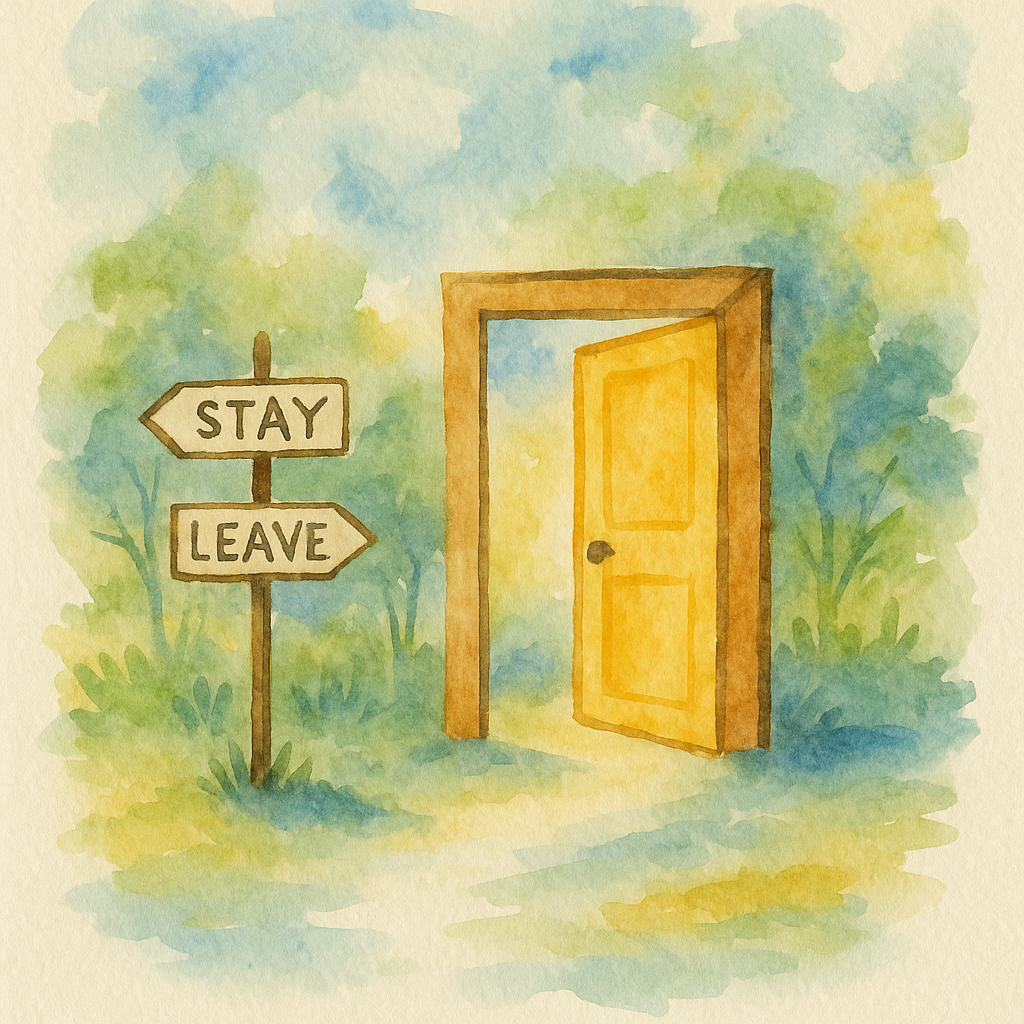
You become who you are by staying long enough to ask the harder question.
I. The Exit Myth
We love an exit. Especially a well-timed, sharply worded one.
The kind that gets a standing ovation in a boardroom or a viral quote block on Instagram.
“Know your worth,” it says. “Walk away from what doesn’t serve you.”
We cheer. We repost. We crave the empowerment of decisive departures.
But real life isn’t an airport departure board. Sometimes, the only way to tell if you’re making the right decision is by living through the wrong one.
I’ve left jobs that looked great on paper.
Walked out of relationships where love was still on the table.
Closed chapters I hadn’t fully finished reading.
Some of those exits were essential. They gave me back my energy, my clarity, my name. Others were clever ways of avoiding discomfort. A shortcut dressed up as self-respect.
We don’t always leave because we’ve outgrown something. Sometimes, we just haven’t learned how to stay through the stretch.
II. The Case for Staying (When No One Is Cheering)
I’ve stayed past my comfort zone more times than I can count.
I’ve stayed in a marriage that no longer looked like the one we entered into—and watched it slowly rebuild into something wiser.
I’ve stayed through the late-stage fatigue of a creative project where inspiration had long since dried up.
I’ve stayed not out of fear, but out of the sharp, sober belief that I wasn’t done yet.
And staying—when done with intention—can be a form of radical presence.
It teaches you how to stay curious when you’re bored.
How to show up without applause.
How to tolerate the growing pains of something that matters more than your mood.
It teaches you what your values look like in practice, not just in theory.
But there’s a fine line.
Stay too long in the wrong place and you become unrecognizable to yourself.
You confuse longevity with integrity.
You confuse sacrifice with depth.
And slowly, the staying becomes a slow erosion, not a commitment.
III. The Mistake We Keep Making
Most people aren’t struggling with the question of whether to stay or go. They’re struggling because they’re asking the wrong kind of question altogether.
The real question is never just “Should I leave?”
The real questions are:
- What would it take to stay well?
- What would it look like to leave without bitterness?
- Who do I become, depending on which choice I make?
These aren’t questions that lend themselves to Google Docs pros and cons lists.
They demand something quieter. Something deeper.
They ask for pattern recognition over time.
They ask for accountability—not just for the outcome, but for the way you carry yourself through it.
IV. Knowing When It’s Time
Here’s what I’ve learned to look for.
If staying costs you your self-respect, your voice, your sense of aliveness—it’s probably time to leave.
If leaving is just a clever way of avoiding pain, a fast-forward button in disguise—it’s probably worth staying a little longer.
If you’re still curious—about the person, the work, the path—it’s not time yet.
And if you’re so disconnected that you’ve stopped asking questions altogether, that’s your answer, too.
No Instagram quote will tell you that.
But your body will. The tension. The dull ache.
The shift in your posture when you walk into the room.
The way your days go quiet around the edges.
You know. You’ve always known.
V. Don’t Just Decide—Do It Well
The real work is not the choice. It’s the way you choose.
Leave with integrity. Leave before you rot.
Stay with presence. Stay if you still have work to do.
Whatever you do—don’t drift.
Don’t wait for the external push to give you permission.
Don’t ghost your own life.
Because whether you stay or go, you’re going to need your full self on the other side.
VI. The Bottom Line
There is no correct answer.
There is only the answer that you can live with when the room goes quiet. The one that builds—not just your resume or your relationship—but your character.
I’ve left too soon. I’ve stayed too long. But I’ve learned to stop waiting for a sign and start listening for something far more subtle: the sound of my own honesty, arriving late but clear.
If you can hear that—if you can stay in the room long enough to recognize your own truth—you won’t need anyone else’s validation.
You’ll know.
And more importantly, you’ll trust what you know.
Leave a Reply