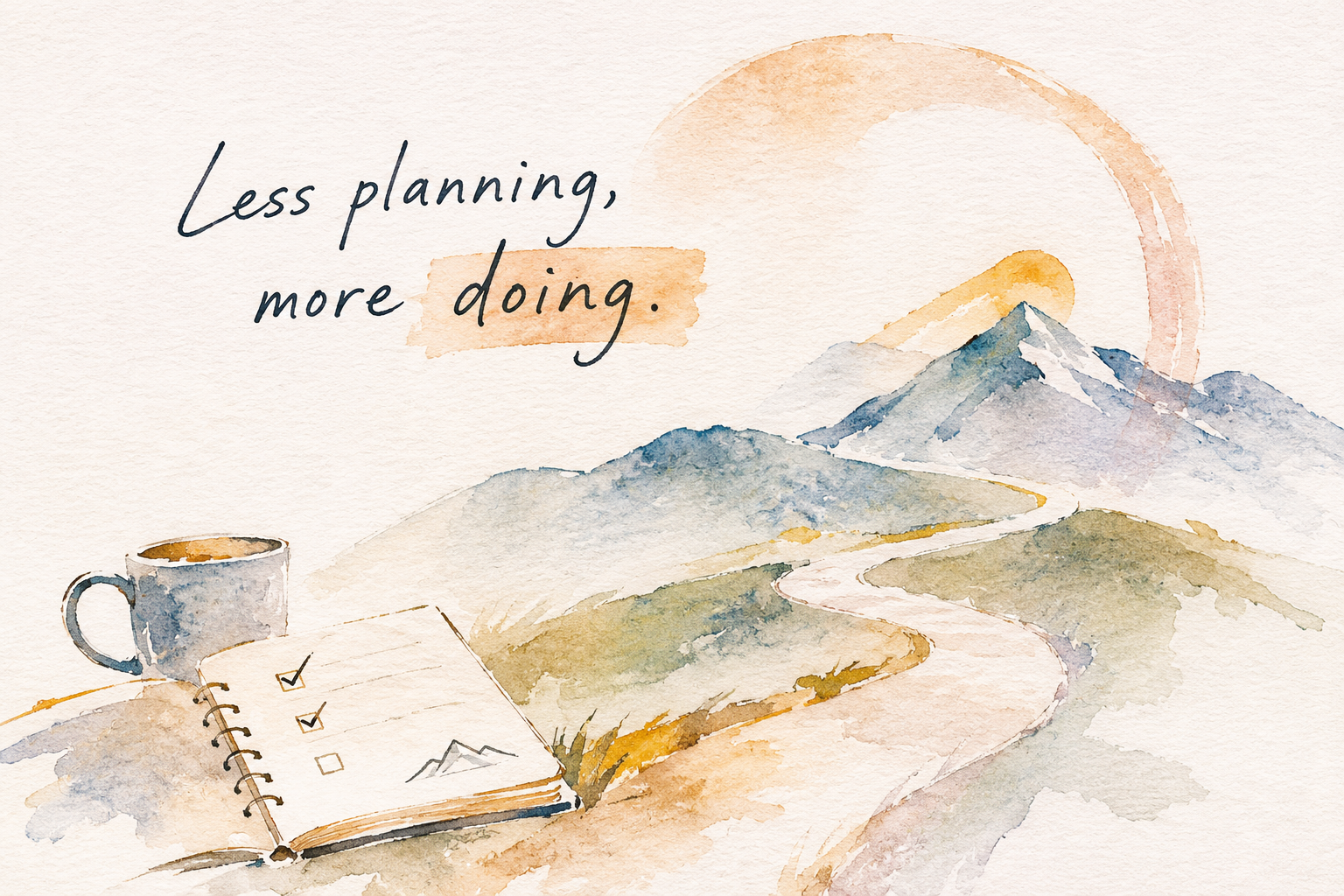
On this sunday morning, I found myself evaluating at my annual plan yet again, wondering how something I was so excited about had become such a source of anxiety. I liked the plan. I liked almost everything in it. Yet, I had spent so much time revising timelines, moving things around and reconsidering priorities that I was beginning to wonder whether I was spending more time organising the life I wanted than actually getting on with it.
I have an ambitious list of things I want to pursue, and enough revised schedules to suggest that planning has become a fairly serious occupation. The funny thing is that I’m rarely short of ideas or enthusiasm. I know the kind of experiences I want, the work I’d like to build and the things I want to get better at. Getting from the excitement of imagining all of it to the rather less exciting business of showing up consistently seems to be where I struggle.
I wonder how much of this has to do with self-trust. A new plan rarely feels like a completely new beginning anymore. Somewhere in the back of my mind, I’m also accounting for previous attempts, things I haven’t followed through on and timelines that have had to change. Even when I’m excited about something, there’s a small question about whether I’ll actually see it through. It’s an uncomfortable thing to admit because I don’t particularly doubt my ability to learn or do difficult things. I seem to have become less certain about my own consistency.
Trekking has brought this into particularly sharp focus. I love the idea of taking on difficult trails, getting stronger and being able to handle terrain that would once have seemed beyond my ability. I’ve experienced enough challenging treks to know what that feeling of preparation and accomplishment is like. I’ve also learnt that enthusiasm and physical readiness are two very different things. A trail doesn’t become easier because you’ve been looking forward to it for months.
I find that distinction useful, even when it’s a little uncomfortable. There are times when my ambitions are ahead of my preparation, and I have to be honest about that. I can either adjust what I’m attempting or put in the work required to be ready. What I don’t particularly want to do is turn a temporary gap between where I am and where I’d like to be into a judgement about what I’m capable of. There’s still a lot I’d like to explore, and I’d rather keep that possibility open.
The interesting thing about trekking is how clearly it exposes the relationship between effort and discomfort. You choose a trail, spend weeks preparing for it and willingly put yourself through a certain amount of physical hardship. Even when the climb becomes exhausting, there’s a reason you’re there. You know roughly what you’re working towards, and the difficulty is something you’ve chosen to experience.
I’ve been thinking about how different that is from the difficulties that life sometimes brings without our choosing them. Those experiences don’t come with a training schedule or a defined route, and they don’t always have an obvious finish line. I’ve sometimes caught myself approaching very different kinds of difficulty with the same expectations I would have of myself on a mountain: keep going, be disciplined, figure it out. It doesn’t always work that way.
Maybe that’s also why I’ve become less interested in comparing what people find difficult. We see the visible effort, but rarely know the circumstances someone is working with or what it took for them to get to that point. A trail that feels manageable to one person might be an enormous challenge for someone else. The same applies to life outside the mountains. I’ve had days when things that would ordinarily seem quite simple have required considerably more effort than I expected. It doesn’t make those days any less real, and I don’t particularly need to justify them against somebody else’s experience.
I used to associate strength quite heavily with physical endurance, discipline and the ability to keep going when things became uncomfortable. I still value those qualities, but I’ve been reconsidering whether that’s a complete picture. There are moments when you can be uncertain about yourself, feel nowhere near your best and still find the willingness to take a step forward. I’ve experienced that in different ways, across work, trekking and life in general. The step isn’t always particularly impressive from the outside, but it can take quite a bit to get there.
This has made me look at my professional life a little differently, too. Working independently gives me considerable freedom over my schedule and the kind of work I want to build. I enjoy that freedom, although it can also make it remarkably easy to spend an entire afternoon thinking about what needs to happen without actually doing much of it. I can move between the website, the job board, the business model and the content strategy, considering how everything should eventually come together, while the immediate task remains untouched.
Writing has a similar effect on me. I can spend an unreasonable amount of time organising ten hours of work when I could probably make more progress by simply sitting down and writing. Breaking it into one hour per blog makes the workload feel entirely different. The task hasn’t changed, but suddenly I have something concrete to do. I don’t need to solve the entire writing schedule before opening a document.
I recognise that I sometimes approach the bigger things in the same way. I want to understand the entire technology stack before building the website, anticipate every feature a business might eventually need and work out how all the different pieces will fit together. Some of that thinking is necessary, but some of it is simply me trying to make decisions with information I haven’t acquired yet. I will understand the business differently after working on it for a few months. I’ll probably change my mind about certain features once I see how people use the product. The version of the plan I have today cannot account for all of that.
The same goes for my annual plan. I’ve been treating it as though every decision needs to be settled in advance, when a reasonable amount of it will inevitably depend on what happens along the way. I don’t particularly enjoy uncertainty, especially when several things I care about are competing for my attention. But repeatedly going back to the drawing board hasn’t necessarily made those decisions any better.
I also notice how quickly I move the reference point whenever something goes well. A professional milestone becomes the starting point for the next ambition. A difficult trek becomes preparation for a harder one. A piece of writing I’m happy with makes me wonder whether the next one will be better. There’s always something further ahead to work towards, and I can become so occupied with it that the thing I’ve just accomplished barely gets any time to register.
When I look back at my experiences, the things I remember most aren’t necessarily the milestones. In recruiting, it’s often the conversations, the people I’ve worked with and the moments when I’ve been able to help someone see a possibility they hadn’t considered before. With writing, it’s the unexpected appreciation from someone who connected with something I put into words. On a trek, the summit is wonderful, but so are the people you meet, the conversations along the trail and all the small things that happen between the beginning and the end.
I don’t think these are simply nice things to remember once the actual work is done. They’re often what make the work interesting in the first place. And yet, when I’m planning the next year, I rarely have a column for any of them. I tend to measure progress through things that can be completed, counted or ticked off, while some of the experiences I value most have very little to do with a final outcome.
Perhaps that’s also why I’ve been reconsidering what success means to me. I’ve always believed in putting in the work, but I’ve caught myself occasionally expecting that enough preparation and effort should make things fall into place. They don’t always. You can work hard and still have to change direction, put something aside or accept that the outcome isn’t what you had in mind. I don’t find that particularly comforting, but I suppose it’s a more honest way of looking at things.
There’s also a difference between wanting to achieve something and believing that an achievement is what makes the effort worthwhile. I want to build a successful business, write more, become a stronger trekker and have the freedom to explore. Those things matter to me. But I don’t want to spend so much time looking towards the next outcome that I miss the people, skills and experiences I’m accumulating along the way.
I’ve become more aware, too, of how much pressure I sometimes put on myself to have everything figured out before I allow myself to get on with it. The well-prepared professional, the physically capable trekker, the writer who consistently produces something worthwhile. It’s a rather demanding image, particularly when the things I’ve enjoyed learning most have involved being a beginner, getting things wrong and occasionally surprising myself.
I don’t think being vulnerable requires having a public account of every difficult experience. There are things I would rather keep private, and that doesn’t make the reflections that come from them any less honest. I can write about how an experience has changed my perspective without having to explain every detail of what happened. I’m increasingly interested in that distinction. I’d rather share something that another person might recognise in their own life than turn my writing into a record of everything I’ve been through.
That also feels like a more useful way of thinking about responsibility. There are circumstances I haven’t chosen, outcomes I can’t determine and things that are simply outside my influence. I’ve spent enough time trying to make sense of all of that to know that not everything has an explanation I’m going to find satisfying. But the decisions I make now, the work I give my attention to and the way I engage with the life in front of me are still mine. I don’t need to pretend I have control over everything to recognise that I have some say in what happens next.
Lately, I’ve also been craving a little more quiet. There’s always something to read, another opinion to consider or another approach that might make a plan better. I can keep gathering information long after I’ve reached the point where I have enough to make a decision. Sometimes I wonder whether all that input is helping me think or simply giving me more things to think about. I’ve been wanting a little space away from it, where I can figure out what I actually want without immediately turning it into another list of things to do.
I still like my annual plan. I want the difficult treks, the business, the writing and the independence. I don’t want to make those ambitions smaller simply because I’ve struggled with execution, but I also don’t want to keep reconsidering the entire direction of my life every time one thing doesn’t go according to schedule.
For now, I’d rather give the things I’ve already decided matter some actual attention. Close the recruitment assignment, write the blog, work on the website, understand the business a little better and put in the hours of training. They’re all fairly ordinary tasks when written down like that. None of them requires me to have a grand theory of how the year will unfold. They just require me to get on with them.
I still have questions about what I’m building, where it’s going and how much of what I’ve planned will eventually materialise. I haven’t suddenly become more disciplined or more certain about any of it. I just seem to be getting a little tired of trying to resolve everything in my head before giving myself the opportunity to find out.
Maybe some of the answers will come from the work itself, from the people I meet, from the next trail and from experiences I couldn’t have planned for even if I’d tried.
I had the whole year figured out. I just needed to get started on Tuesday.
Leave a Reply