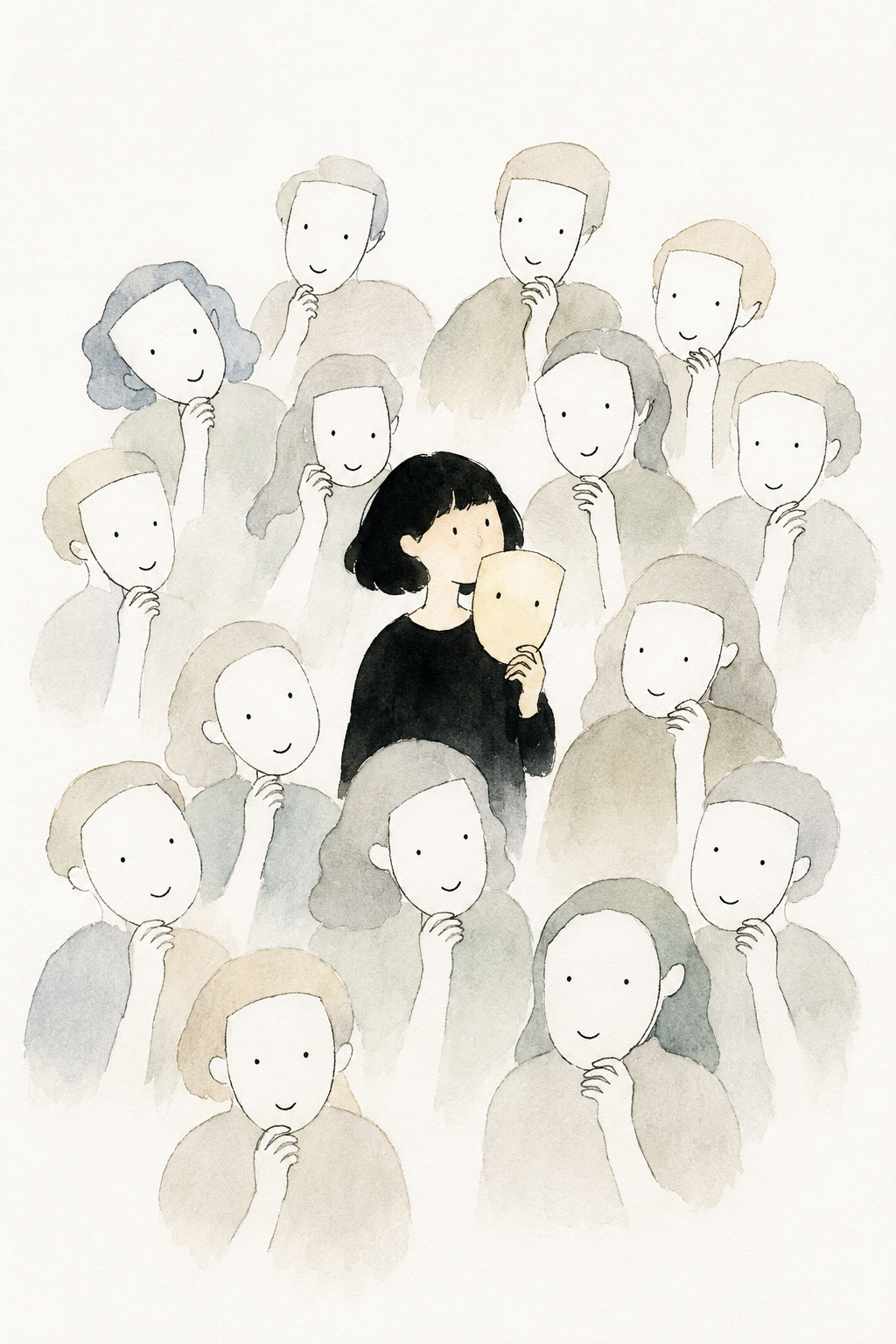
People say, be honest with yourself.
But what the hell does that even mean in your life? And how often does that question need to be redirected to yourself?
When something is making you pull your hair out— maybe another person, work, relationship, choices you’ve made, life you’ve built— it’s very easy to become consumed by the question of what is happening outside you.
Why isn't this person being honest?
Why don't they see what I see?
Why does this keep happening?
Why can't things be different?
But what if, somewhere alongside those questions, there is another one worth sitting with:
Where in my own life am I not being honest with myself?
What am I not accepting?
What am I not facing?
What have I already understood but haven't really allowed myself to acknowledge?
That question becomes complicated very quickly, because reality isn’t always a neat exercise in projection. Two people can experience the same life and genuinely want different things.
One person might be thinking about what would make them look back from their deathbed and feel that they had actually lived — time, intimacy, freedom, adventure, ordinary days that weren’t swallowed by work. The other might genuinely believe that working incredibly hard, building something extraordinary, breaking world records, winning Olympic gold, leaving a legacy— that’s what gives their life meaning.
So one person is asking, When are we going to have our life? while the other is thinking, This is my life. This is what I want to do with it.
What happens when both people are telling the truth? That question interests me much more than figuring out who is right.
Because perhaps this isn’t only about two people. We run into versions of the same conflict everywhere.
You become a parent and, a year or two in, discover that you don’t actually want the life of constant responsibility and sleepless nights. Something that everyone told you would eventually feel meaningful, one day.
You spend years being the caring son/daughter, re-arranging your whole life around care-giving for your ailing parents, only to discover that they have given a massive part of their inheritance to the sibling who barely showed up.
You become the founder of a company. You get the dream job, the title, the money, the recognition. You have built exactly what you thought you wanted, and then you find yourself wondering why all of it feels strangely distant from the life you actually want to wake up to.
Maybe what you want is peace or to live in a local homestay in the mountains or to start an NGO.
Maybe you want something that doesn’t look particularly impressive from the outside at all.
And maybe you don’t even know what you want.
There is only this persistent sense that the thing you have spent years pursuing is not answering the question you thought it would answer.
There is something significant about the moment a vague dissatisfaction becomes something you can actually name. Before that, you can keep negotiating with it.
You can call it burnout.
You can call it a phase.
You can tell yourself that you are ungrateful, exhausted, confused, going through a difficult year.
You can wait for the promotion, the holiday, the next milestone, the next birthday, the next year.
But once you can say, I don’t think I want this life, what happens then?
Because now the problem isn’t that you don’t know. The problem is that you know. And knowing can be its own kind of burden. Especially when the thing you have realised, threatens the identity you have spent years constructing.
What if you have built your whole sense of yourself around being the successful one, the caring daughter, the dependable partner, the ambitious founder, the person who takes care of everyone, the person who never gives up?
What if you have spent years doing things for your so-called people, believing that all this loyalty and sacrifice would eventually make sense because the people you were doing it for would value you in the same way?
What happens when you begin to suspect that the bargain you thought you had made with life was never really a bargain at all?
This is where I think the popular conversation around authenticity becomes strangely shallow.
Be yourself. Follow your dreams. Take the leap of faith.
But what exactly happens after you finally admit what you want?
Because honesty doesn’t automatically give you a roadmap. Sometimes it gives you a problem.
You can know you don’t want your career anymore without knowing what you would do instead.
You can know you want to live somewhere else without knowing how you would earn a living there.
You can know you want to build something of your own without having the skills to build it.
You can know that you want a completely different life while still being deeply dependent on the stability of the life you currently have.
And what lives inside that distance?
Fear. Money. Skills you don’t have yet. People you might disappoint.
A place you might have to leave.
A relationship that might change.
A family that may not understand.
A career you spent fifteen years building.
And the particularly brutal question underneath all of it: What if I give up everything I have and still fail to build the life I want?
There is something almost cruel about how casually we talk about taking a leap of faith. The phrase makes the jump sound like the difficult part.
But perhaps the more difficult thing is everything that comes after you have admitted that you want to jump and before you know where you are going to land.
- What does that period actually look like?
- What does it feel like to wake up knowing that your old life doesn’t fit anymore, while having no idea what your new life is supposed to look like?
- What do you do when you have a dream but no skills?
- What do you do when you have a desire but no money?
- What do you do when you have an idea but no evidence that it will work?
- What do you do when everyone around you thinks you are throwing away something valuable, and you aren’t even completely sure they are wrong?
Maybe this is why people stay in lives they have quietly outgrown. Not because they are incapable of seeing the truth, but because the truth doesn’t come alone. It brings a whole set of consequences with it. The dishonest life can be incredibly functional.
You know how to live it. You know how to be that person.
You know what you are good at. You know how the money comes in.
You know what your family expects. You know what your friends recognise in you. You know where you fit.
The honest life may begin with nothing more than a sentence you are not yet equipped to build around. I don’t think I want this anymore.
And perhaps that is why accepting the truth can feel like giving the demon inside you a name. Before it had a name, you could keep negotiating with it. Once it has one, you have to decide what to do with the knowledge.
There is another strange thing about this:
Sometimes you don’t just have to change your circumstances. You have to become someone capable of living differently.
- If your entire identity has been built around achievement,
what happens when the life you want requires you to become a beginner? - If you have always been the person everyone depends on,
what happens when you want a life in which you aren’t constantly needed? - If you have spent years creating stability,
what does it feel like to deliberately enter a period where things are uncertain? - If you have spent your whole life knowing how to succeed according to someone else’s definition,
what happens when you have to create your own definition and then live without anyone being able to tell you whether you are doing it correctly?
That period can be incredibly lonely because there isn’t always a clear transition from one identity to another. Sometimes the old version of you is still functioning perfectly well.
You can still do the job. You can still fulfil the role. You can still achieve. You can still make everybody else comfortable.
But something inside you has moved. And now you have to live with the fact that you have seen something you cannot completely unsee.
Perhaps this is also why becoming honest with yourself can involve so much grief. Not because the old version of your life was necessarily terrible, but because you may have genuinely loved parts of it.
You may have genuinely wanted the career.
You may have genuinely wanted to be the good son/daughter/wife/husband/parent.
You may have genuinely wanted the family, the company, the achievement, the security.
- What do you do with something that was once true but isn’t anymore?
- Do you call the old life a mistake just because you have outgrown it?
- Do you resent the person you used to be for not knowing what you know now?
- Or can you hold the more uncomfortable possibility that the person you were was making the best choices they could with the information, experiences and needs they had at the time?
And then there is the part nobody really sees.
People see the person who eventually changes their life. They see the move, the career change, the new company, the new relationship, the new place, the decision that finally became visible.
But what happened before that?
How many years did that person spend trying to make themselves want what they were supposed to want?
How many times did they dismiss the feeling because there was no practical solution yet?
How much time did they spend learning to tolerate the possibility that the life they had built might not be the life they wanted to keep?
How many skills had to be learned before that change was even possible?
How much uncertainty did they have to sit with before they could make a decision without knowing whether it would work?
That is the part that disappears from the finished story.
We look at the tip of the iceberg and call it courage. We don’t see the enormous amount of ice beneath the water — the years of experiences, contradictions, grief, questioning, experimentation and slow formation that made that visible decision possible.
And maybe that is what makes honesty with yourself so much harder than the phrase suggests.
The difficult question isn’t always What do I want? Sometimes it is:
What would happen if I admitted that I already know?
What would I have to give up?
What would I have to learn?
Who might I disappoint?
Which version of myself would I have to let go of?
What would happen to the life I have spent so much time building?
And perhaps, underneath all of that, is the question that makes the whole thing so frightening:
If I become honest about what I want and I still fail to build it, what will I have left?
Maybe that is why people can spend years hovering around the truth. Not because they are incapable of seeing it. Because sometimes seeing it is the easy part.
Living with what you have seen is where everything gets complicated.
Leave a Reply