All takes on Elon splits the room before the headline is done.
One camp sees a wizard who bends physics. The other sees a lucky asshole with too much leverage and no scruples.
And while both sides argue about who he is, almost nobody pauses to ask what actually matters:
how does he work?
It’s less glamorous, which is probably why it gets overlooked—but that’s where the core truth hides. Not in his beliefs or personality, but in the texture of his days: how he decides, what he ignores and what he pushes on when everyone else backs off.
He’s smart, well above average, but the IQ delta between him and a strong engineer doesn’t come close to explaining the output delta.
Something else is doing the heavy lifting. Once you understand it, you start noticing its absence everywhere in your own damn life. And that’s what makes people uncomfortable.
Multiplication beats addition
Most of us treat productivity like a savings account because no one taught us about index funds.
We read a bit more, plan a little tighter and squeeze in a 15 min morning workout.
By the year’s end, the needle moves by a polite margin. It is good enough for a performance review, so we call it progress.
Elon doesn’t add effort. He multiplies it.
Working hard on the wrong problem gets you nowhere,
the right problem without vision gets you nowhere,
and vision without action gets you nowhere
— but stack all three in order and each choice multiplies what came before.
A single lever gives you a 50% edge over the average operator. A modest gain. But levers don’t add. They multiply.
Stack four levers over 30 years, and the math creates a singularity. The world calls it magic because they lack the vocabulary for compounding.
He runs compound interest on his decisions. We run simple interest on our calendars.
Urgency is the thing he’s actually building
He behaves as though cash is physically leaking out of the building while he’s standing in it.
In it’s early years for SpaceX, he ran mental math that said someday this business will do $10M a day. Which means every 12 hours of organisational slack is $1M of future revenue being casually set on fire. The math is debatable but not the behaviour change it results into.
He orders surges nobody needs.
He sets a Thanksgiving weekend launch when no customer is paying attention.
He demands a hole dug in the parking lot at midnight when the permits office opens in nine hours anyway.
None of those moves are rationally optimal, and they were never supposed to be. They exist to keep the team’s pulse running at the rhythm his pulse runs at, because once a team slows to a comfortable human rhythm, it never speeds back up.
I think about this every time I watch a company hold the third quarterly planning meeting about a feature that should have shipped before the second one. The work isn’t hard. Everyone in the room stopped being in a hurry three years ago, and you can feel it in the carpet.
The idiot index
This one will follow you home.
Take any object. Divide what you paid for it by what the raw material in it actually costs. The ratio is the idiot index, and it tells you how much pure stupidity is sitting between you and the periodic table.
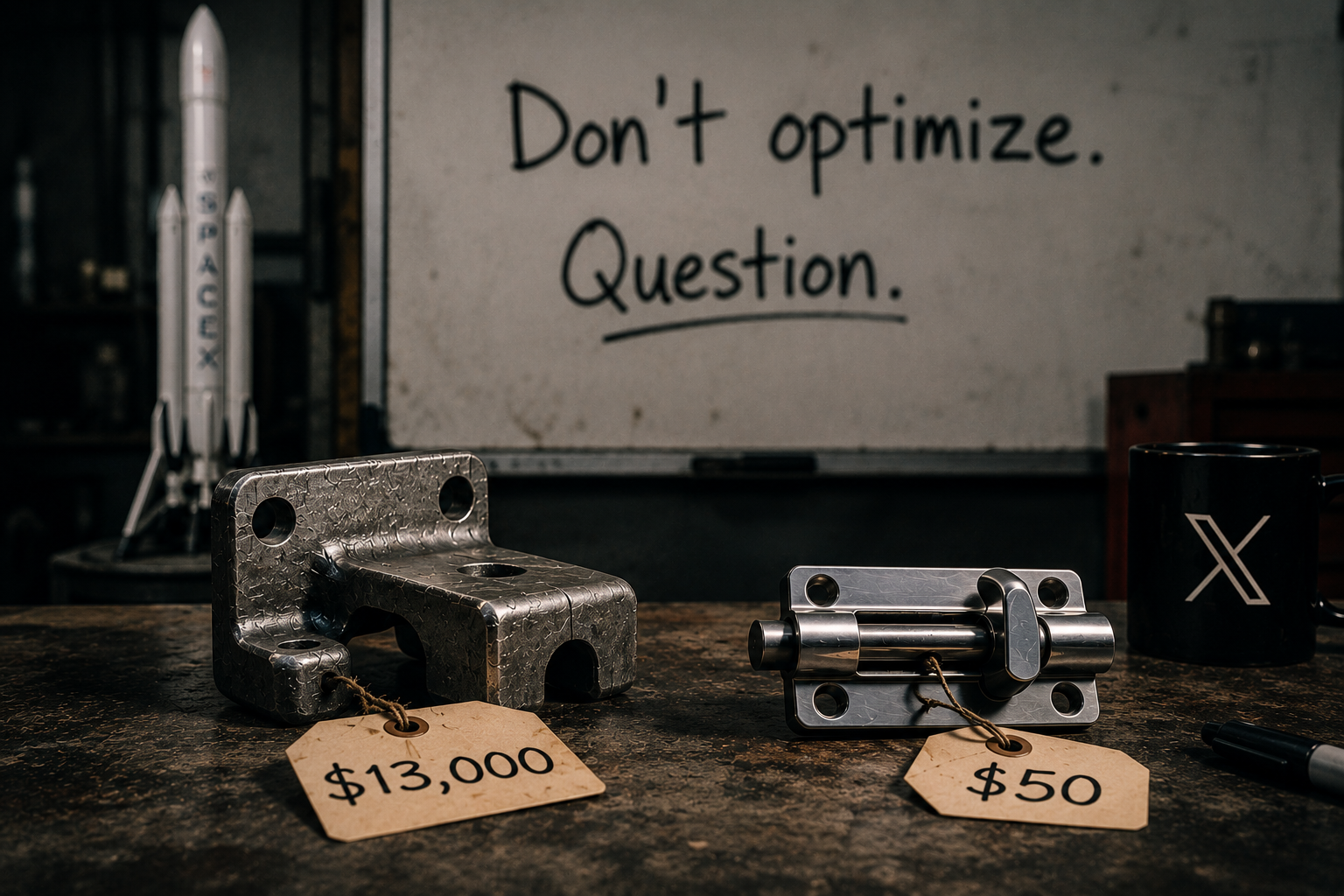
A rocket bracket that cost SpaceX $13,000 contained roughly $200 of steel. Idiot index, 65.
64 units of subcontract markups, layered procurement, certification theatre and inherited habit, all hiding inside that price tag waiting for someone willing to look.
One of his engineers stared at a $1000 aerospace latch one afternoon, walked into Home Depot, bought a 50-buck bathroom stall latch, modified it slightly, and clawed back $950/unit across the rest of the production run.
A bathroom stall latch flying on a rocket is the entire philosophy in one image.
Most companies skip the calculation because the buyer is the government, the customer is captive, or someone signed a contract two years ago that nobody wants to be the one to challenge. Overpaying by two orders of magnitude becomes wallpaper, and wallpaper is the most expensive thing in any building because nobody sees it.
Fun fact – The idiot index has almost nothing to do with steel.
My credit card statement has one. My calendar has one.
The standing meeting every Wednesday at 3 has a brutal one.
The gym membership at the place I drive past on the way to the gym I actually go to.
The subscription I keep renewing out of inertia.
Each one carries a number, and most of those numbers are alarming, and we never run them because to run them is to admit that we’ve been the procurement officer of our own life and asleep at the desk for a decade.
Delete the thing before you optimise it
The best component is no component. The best process is no process.
School trained us to solve whatever was on the page, because you cannot refuse a question on a test. Life isn’t a test, though, and most of the questions on your page were put there by someone who never asked whether the page should exist.
His algorithm flips the order.
Question whether the requirement exists at all.
Try aggressively to delete the component.
Only then optimise whatever survived the cull.
Most of us run this exactly backwards. We polish, automate, A/B test, refine. 18 months later we discover the thing we’d been polishing should have been killed at the start.
Motion isn’t progress. Motion is what guilt looks like when it’s busy.
His relationship with losing is built differently
He isn’t a gambler in the way people use the word. He’s running a different cost function, and the function is uncomfortably plain.
Failure is irrelevant unless it’s catastrophic.
If a bet doesn’t kill you or kill the mission, it didn’t cost you anything that genuinely counts, so why would you decline it.
Most people stop swinging after one public loss, because looking foolish in front of strangers feels worse than the actual financial damage.
He either doesn’t feel that social cost or trained himself out of feeling it as a child, and that emotional asymmetry is the real freedom hiding inside his operating style.
He keeps swinging long after everyone else has gone home embarrassed, because the embarrassment never registered as a meaningful expense.
He also picks deadlines he believes he has a 50-50 chance of hitting, and he misses half of them on purpose.
Anyone hitting every deadline they set is being too conservative and quietly burning years of compounding to caution.
That sounds like a slogan, but it’s worth sitting with. If you hit 95% of last year’s goals, you set the wrong goals. You optimised for the feeling of finishing rather than for the size of the finish.
Parallel beats sequential, almost always
The standard founder script says focus. Build one thing, win, then start the next.
He ignored the script. Tesla and SpaceX simultaneously, from cold, while broke and divorced and being mocked weekly by the financial press. Then Neuralink, the Boring Company, X, xAI, Optimus, a political adventure on top.
Either Tesla or SpaceX alone would put him on any reasonable list of the greatest entrepreneurs alive. Doing both at once is the part of the story that breaks the standard model.
Buffett’s old line about babies and pregnant women gets used constantly to defend sequential focus, and the line is misquoted 90 of the time it’s used. The pregnancy itself can’t be shortened, fine. The pregnancies don’t have to be run one after another, though.
You can run 9 of them in nine months instead of stretching them across 81.
Most of the things you’ve been queueing sequentially in your own life are pregnancies you could have started years ago without them interfering with each other.
The book and the side business. The savings habit and the fitness rebuild. The hard conversation and the move to a new city.
Sequential feels grown-up. Sequential is mostly a polite name for procrastination, and the cost stays invisible until you’re 40 and the queue hasn’t moved.
Purpose is what stops the whole thing turning into a horror show
Strip purpose out of any of this and the same behaviours curdle into something uglier.
The 100-hour weeks become martyrdom.
The surges become abuse.
The deletions become recklessness.
The parallel projects become attention deficit dressed up as ambition.
The willingness to look foolish in public collapses into the species of narcissism you avoid at dinner parties.
These traits survive as personality features only when the mission underneath them is heavy enough to justify the human cost of running at that intensity.
Making life multiplanetary so consciousness has a backup.
Electrifying transport so the climate problem has a chance.
Building neural interfaces so paraplegics get their hands back.
Missions of that size attract serious engineers willing to be screamed at by a man who hasn’t slept properly in a decade. Without that gravitational pull, the same behaviour produces an angry guy yelling at exhausted people for reasons no one can identify.
The mission is what makes the intensity bearable for the people enduring it, and presumably for him too.
The engine and where it came from
A boy beaten so badly by a gang of kids that he was unrecognisable in a hospital bed afterwards.
A father who showed up and sided with the bullies, calling his son stupid for picking a fight he was always going to lose.
Hours of standing at attention in front of that same father, as a child, being told he was worthless, useless, a disappointment.
You don’t walk away from that. You build something inside yourself that refuses to switch off, and you spend the rest of your adult life trying to find missions large enough to absorb the heat.
He’s allergic to peace. He hunts for the next war before the current one is finished.
He manufactures urgency when the world fails to supply enough of it on its own.
The wiring that makes him miserable to work for produces the rocket, the car company, the overnight rebuild of a global social network.
You can’t separate the output cleanly from the source. They’re welded together at the spine.
There’s a reading of this story where it lands as tragedy. A man who never gets to enjoy what he’s built, because whatever drives him won’t tolerate the stillness required to enjoy anything.
There’s another reading where it lands as accidental gift. Humanity ends up with electric cars and reusable rockets and a real shot at multiplanetary life because a beaten kid in apartheid-era Pretoria couldn’t tolerate silence.
Both readings are true simultaneously, and anyone asking you to pick one is being dishonest with you about the trade on the table.
The methods are portable. The biography isn’t, thankfully.
You can borrow the idiot index without borrowing the childhood.
You can run the delete-before-optimise rule on a Tuesday morning calendar without sleeping on a factory floor.
You can start 3 things in parallel this month without alienating everyone who loves you.
The mistake most readers make with a life like his is to either dismiss the whole package as inhuman, or to swallow the whole package as a blueprint.
Both moves miss the actual offer, which is that the tools work in any hand willing to pick them up, separated from the engine that originally forged them.
He looked at things everyone else had quietly agreed to stop looking at, and asked the boring, embarrassing questions they’d been skipping for years.
The bracket costs how much. The latch does what exactly. The deadline assumes what about whom. The pregnancies have to be sequential because of which law of physics, exactly.
That’s the entire trick. Everything else is theatre.
Leave a Reply