The peanut butter sandwich that changed everything was objectively terrible—stale bread, cement-thick filling—but I was sitting at 4,247 feet with steam rising from my socks when the math finally added up:
thirty-eight years of carrying weight that was never mine to begin with.
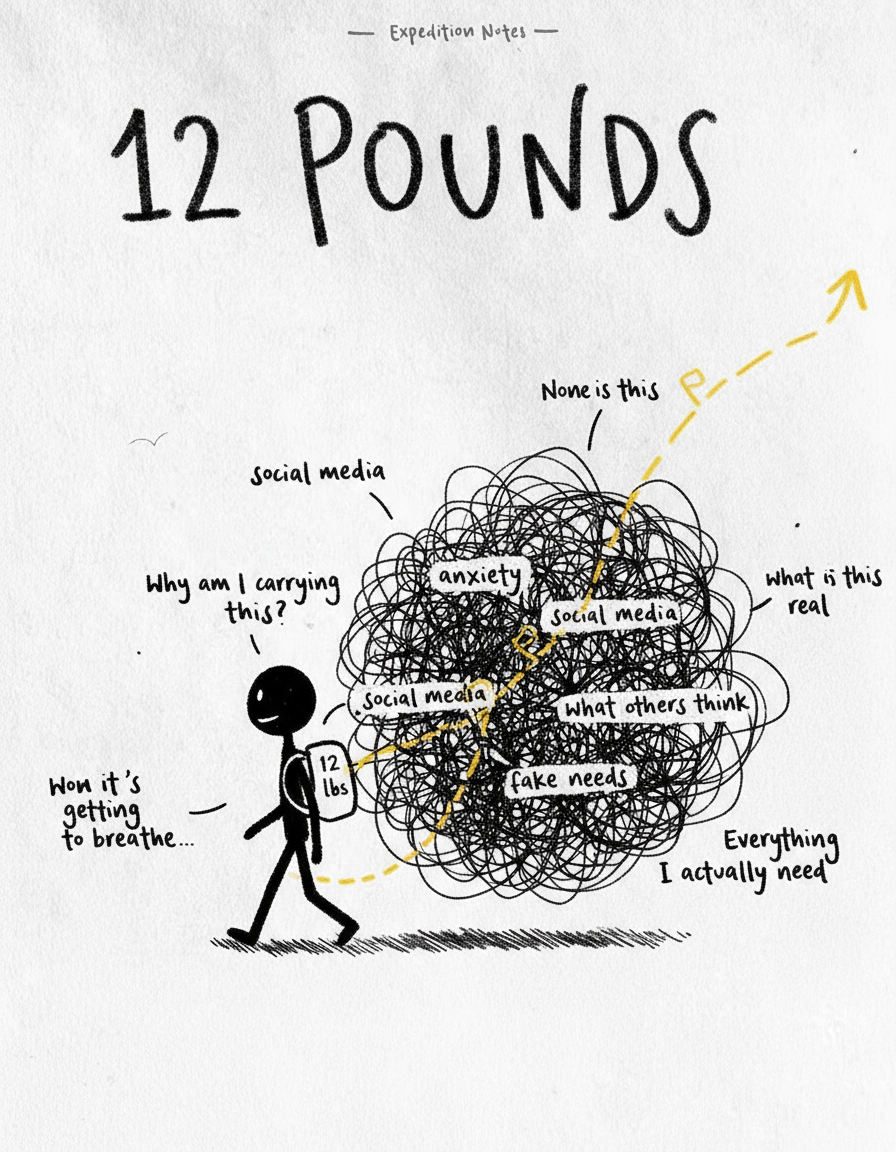
The sandwich was terrible—stale bread, cement-like peanut butter—but I was sitting on this waterlogged piece of wood with steam rising off my socks, and I felt lighter than I had in years. My feet were destroyed, my shoulders ached from carrying twelve pounds that somehow felt heavier than my mortgage, and I was genuinely happy for the first time since before I started checking my ex’s vacation photos at 2 AM.
This makes no sense until you understand that the thing crushing me had nothing to do with what was strapped to my back.
“We’ve been carrying so much invisible stuff,
we forgot what really weighs us down.”
Three days earlier, I’d walked out thinking those twelve pounds contained everything necessary for survival. Now, watching condensation rise from my gross socks, it hits me:
Most of what we drag through life isn’t stuff we need
—it’s just fear wearing an expensive disguise.
The rain started exactly three hours in, vindictive rain that finds every gap in your supposedly waterproof gear and moves in like that friend who crashes on your couch for “just a few days” and is still there at Christmas. Standing under what you might generously call shelter—a pine tree that looked like it had been through a few too many breakups—I had this moment of honesty:
My mother was right about everything,
especially the part about me making questionable decisions.
No car keys in my pocket, no backup plan involving room service. Just me and whatever was about to start playing in my head now that I couldn’t reach for my phone every thirty seconds.
Which is when I discovered that anxiety without Netflix is a completely different beast.
When Your Brain Becomes Your Worst Roommate
Back home, anxiety shows up and I immediately dive into Netflix like it’s shelter. Boredom walks through the door and I’m scrolling TikTok until my thumb gets sore. Loneliness knocks and I’m texting people from high school just to see those three dots that prove I still exist somewhere.
I’d built my entire adult existence around avoiding moments where I might have to sit alone with my own thoughts,
which seems reasonable until you’re stuck in the woods with your brain and zero escape routes.
“I’d spent years building a fortress designed specifically to avoid uncomfortable moments between thoughts.”
That first night proved exactly why this strategy had been necessary. Every sound turned into a potential wildlife documentary gone wrong, and I finally understood why most people avoid this scenario.
Being alone with yourself isn’t scary because of what might be lurking outside. It’s scary because of what’s definitely been lurking in your head,
throwing a constant party while you’ve been too distracted to notice.
My mind, suddenly cut off from its usual entertainment, started acting like a toddler given too much sugar. It dug up conversations from 2003, replayed every embarrassing moment from seventh grade, then started manufacturing disaster scenarios that would make news headlines seem optimistic.
Because apparently worrying about whether I’d left my straightener plugged in was now more pressing than figuring out wilderness survival.
Day two felt like the universe had taken my life choices personally. My legs had turned into concrete overnight, my feet developed angry spots, and my brain settled into complaint mode with real enthusiasm.
“This is awful. Why am I doing this when I could be home eating ice cream from the container like a normal person having a crisis?”
Then day three walked in and changed everything.
The Day Everything Shifted
My brain apparently got bored with its own drama, the way you eventually get sick of hearing yourself complain and just stop. That constant mental noise started settling into something manageable—
like finally finding the volume button on your life.
The shift wasn’t gradual. Morning light filtering through fog had this incredible quality when I wasn’t immediately thinking about Instagram captions.
Silence isn’t just the absence of noise—it has actual weight, thick and comforting in deep woods, thin and sharp across open meadows.
But what really changed everything was realizing I couldn’t delete uncomfortable thoughts anymore. The job crisis I’d been avoiding since spring but hadn’t actually addressed beyond saving anxiety memes and googling “is it too late to completely change careers at 38” at 2 AM. The moment I stopped trusting my own judgment and started polling friends before making any decision more significant than coffee orders.
All this suppressed stuff started bubbling up while I was hiking uphill, sweating more than seemed reasonable, or lying awake listening to something large crashing through trees.
“When you can’t grab your phone to make uncomfortable feelings disappear with cat videos, truth stops making appointments and just shows up.”
This is exactly what happened on day four, when my body decided to teach me about lies I’d been believing.
Your Body: The Ultimate Con Artist
My body runs a pretty sophisticated con operation.
It convinced me I was having a medical emergency when I was just tired from staying up too late watching Netflix. Swore I absolutely could not take another step when I probably had more reserves than I knew.
I’m climbing what feels like a wall in heat that would make anyone complain, and my body decides to stage a revolt. Every part of me screams for surrender with arguments that sound reasonable:
“This is too much! Think of your responsibilities!
Your houseplants! That Netflix series you’re halfway through!”
“My body had been running a manipulation campaign better than my worst ex, and I’d been falling for it.”
Every voice in my head reached the same conclusion:
I was done, and continuing was about as smart as texting my ex at 3 AM after seeing them with someone new.
But surrender wasn’t actually an option. No air-conditioned building was waiting around the corner. No “skip this part” button existed.
So I kept moving, ignoring my body’s increasingly desperate negotiations, the way you ignore LinkedIn messages about “exciting opportunities” when you can barely handle your current job.
Thirty minutes later, something changed everything I thought I knew about my limits.
I was fine.
Not comfortable—still sweating like crazy—but totally functional and definitely not experiencing the emergency my body had been advertising.
My body had been running a misinformation campaign, trying to convince me that comfort and growth couldn’t coexist.
This set up what happened the next day perfectly.
When You Stop Performing Your Life
Day five was when I finally stopped trying to turn every moment into content for an audience that existed only in my head. I stopped analyzing every thought like I was providing commentary on my own experience. Stopped mentally composing social media posts before I’d even learned anything.
I just existed.
Walked when it felt natural. Ate when hungry.
Slept when tired. Paid attention to whatever was in front of me without trying to extract life lessons from every pine cone.
“The most radical thing you can do in a world that profits from your dissatisfaction is just be okay with who you are right now.”
That’s when things got interesting. Colors looked more vivid, like someone had cleaned a filter I didn’t know was there. Food tasted incredible—even those cardboard energy bars suddenly seemed decent.
I started laughing at completely ordinary things:
→ A squirrel giving me attitude about proper forest etiquette
→ Carrying everything I needed to survive in something smaller than my usual purse collection
→ Voluntarily choosing discomfort for reasons that would sound insane to anyone with Wi-Fi
I felt lighter despite the pack on my shoulders. Not physically—my feet still hurt—but mentally lighter, like I’d been dragging invisible luggage and finally realized I could just set it down.
That constant low-level anxiety that had been my adult life’s background music simply disappeared. Not replaced by fake happiness, but by something more solid,
like finally finding your natural breathing rhythm.
This feeling followed me all the way to that soggy log and that terrible sandwich.
The Person Who Finally Logged Off
Sitting there eating what became the most memorable peanut butter sandwich of my life, I realized I didn’t want this to end. Not because I’d fallen in love with sleeping on rocks, but because
I’d gotten curious about who I might become without constant digital input telling me who I was supposed to be.
The person getting ready to return felt different from the one who’d left six days earlier,
like when you recover from being sick and suddenly remember what healthy feels like.
“I felt different—like relief from pain you didn’t know you were carrying.”
Back home, unpacking that twelve-pound bag revealed the truth. I spread everything across my bed like evidence from a crime scene where the only thing stolen was my assumptions. A few changes of clothes, basic shelter, minimal food, water purification tablets, tiny first aid kit.
Everything I’d actually needed to thrive for almost a week.
Everything else—all the stuff crammed into every space, all the apps competing for my attention, all the obligations I’d convinced myself defined my worth—suddenly felt completely optional.
The old me would have immediately started creating systems to optimize these insights, complete with spreadsheets and vision boards.
But I understood something simpler:
This wasn’t meant to become another self-improvement project.
It was meant to change how I moved through the world.
What Really Matters
That moment, sitting at 4,247 feet with steam rising from my gross socks, taught me something thirty-eight years of accumulating stuff never could:
“The weight crushing me wasn’t what I was carrying—it was what I thought I needed to carry to prove I was doing life right.”
Most boundaries I believed in were about as real as those pop-ups telling me I’d won a million dollars. Just stories I’d been telling myself to avoid temporary discomfort that probably would have led somewhere interesting.
The distance between who you are and who you could become isn’t about time or money or followers.
It’s about being willing to sit still long enough to meet yourself without all the noise we use to avoid that conversation.
“Sometimes the most rebellious thing you can do is just set it all down and walk away.”
The heaviest thing you’re carrying is probably the belief that you need to be carrying so much in the first place.
Because sometimes the most life-changing advice comes from the most disappointing sandwich at the worst possible time in the most uncomfortable place you never wanted to be.
💬 Share this if you’ve ever felt like you’re drowning in stuff you don’t actually need.
Leave a Reply