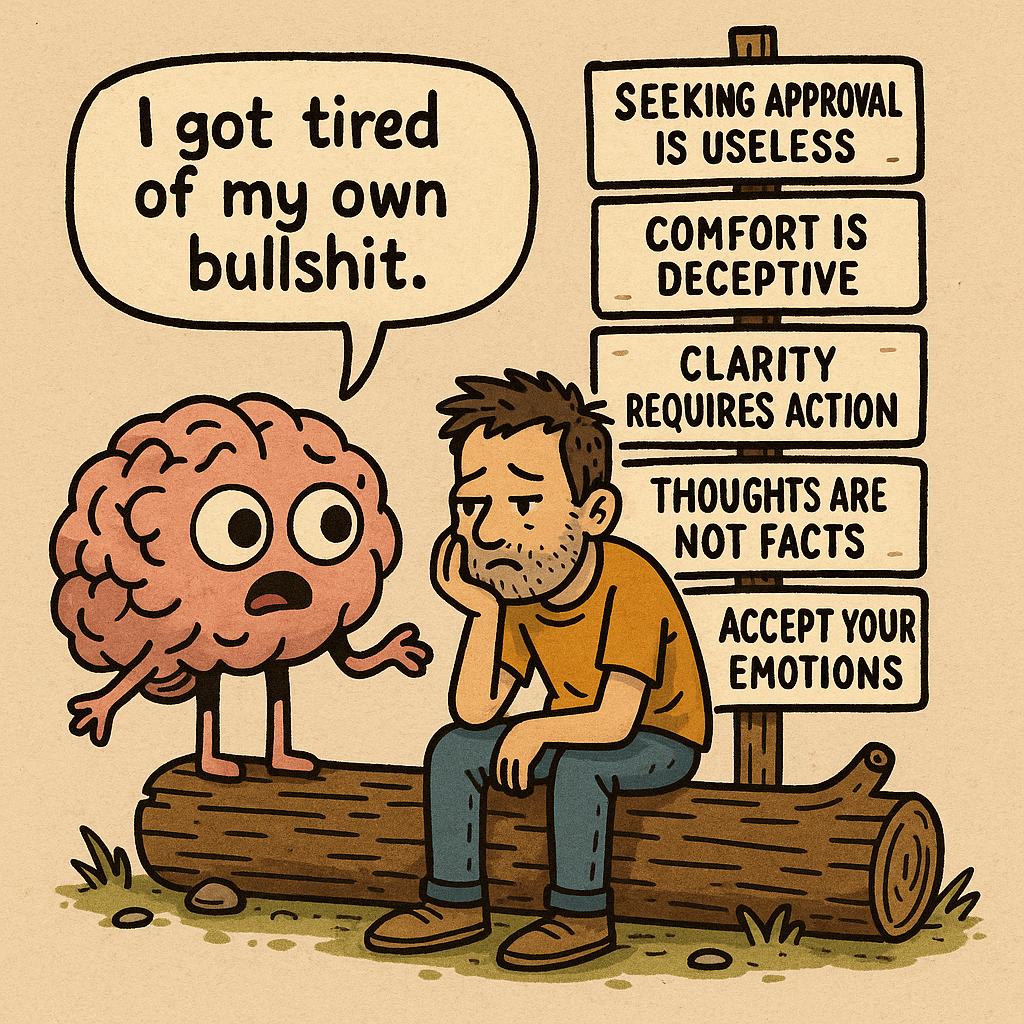
The funny thing about “personal growth” is that it doesn’t tap you on the shoulder dramatically. It sneaks up in a much ruder way. You’ll be doing something ordinary—washing dishes, scrolling, pretending to work—and suddenly you hear your own thoughts and think, Oh god, I’ve been running the same pattern for years and calling it destiny.
That’s how it happened for me. Not a crisis. Not a transformation. Just a quiet, slightly humiliating moment of clarity where I realised the gap between my intentions and my behaviours had become… noticeable.
The endings of all my problems were already written inside my habits. I just refused to read them. These six truths were the highlighters.
I didn’t choose them. They cornered me. And I’m still learning them, which is why I’m telling you this like a confession, not a TED talk.
1. Approval Wasn’t My Drug of Choice—It Was My Default Setting
If someone had asked me years ago whether I cared deeply about how others saw me, I would’ve laughed. I had this self-image of being bold, outspoken, self-driven.
And then one day, I caught myself mid-sentence—softening what I really wanted to say so the other person wouldn’t feel uncomfortable. It felt small, harmless, even polite. But it wasn’t the first time. It had become a reflex, so automatic that I didn’t even know it was happening.
Approval didn’t arrive in dramatic forms. It arrived in microscopic edits—changing my tone, adjusting my posture, shrinking my desires by five percent so they wouldn’t sound too sharp.
It was death by a thousand small concessions.
The contradiction was painful: I wanted to be fully myself, yet I kept trimming myself like a bonsai tree so I wouldn’t take up too much space. Once I noticed this, I couldn’t unsee it. The conflict was plain. Either I kept choosing approval or I chose myself. I couldn’t do both.
2. Comfort Wasn’t Rest—It Was a Clever Disguise for Avoidance
There’s comfort that heals you, and then there’s comfort that sedates you just enough that you stop noticing you’re stuck. I had mastered the second type. I’d convince myself I was “being gentle” or “listening to my body,” when in reality I was bargaining my dreams away for a slightly easier afternoon.
Comfort is tricky because it uses the language of kindness.
You’ve worked hard enough.
You can start tomorrow.
Don’t push yourself.
It felt nurturing. And sometimes it was. But more often, it was the emotional equivalent of choosing warm water because cold water requires you to flinch.
What startled me was how much I was willing to give up just to avoid discomfort—ideas I cared about, plans I claimed mattered, changes I swore I wanted. Comfort wasn’t neutral; it was persuasive. And it always convinced me to choose the present version of me, even when she was the obstacle.
3. Clarity Only Showed Up After I Moved, Never Before
This truth felt unfair.
I spent years assuming clarity was something you earned by thinking hard enough, writing enough lists, researching enough options. I genuinely believed if I contemplated something from every possible angle, certainty would eventually appear like a prize.
It never did.
Instead, something else kept happening.
I’d take one tiny, reluctant action—usually fueled by boredom, frustration, or mild self-disgust—and suddenly the fog would shift by an inch. I could see just enough to take the next step. Never the whole path. Just the next metre.
Clarity wasn’t something I unlocked by thinking. It was something I stumbled into by messing up a little and learning from the mess.
It annoyed me how simple it was.
But the contradiction was real: the more I waited to feel ready, the more unready I became.
4. My Thoughts Were Dramatic, Persistent, and Often Utterly Unreliable
If someone followed me around transcribing my internal monologue, they’d assume my life was far more intense than it actually is. My brain turns minor inconveniences into emotional earthquakes. A neutral text becomes a threat. A quiet day becomes a crisis. A slow morning becomes a character flaw.
The problem wasn’t that I had these thoughts; everyone does. The problem was that I gave them authority. I treated them like headlines instead of background noise.
The visual that finally helped me was imagining my thoughts as characters entering a giant room inside my head. Some walk in calm and reasonable. Others stumble in drunk and dramatic. The trick is noticing who’s talking, not blindly obeying the loudest voice.
Once I saw my thoughts as visitors instead of dictators, I stopped arguing with them as if they were facts.
5. Acceptance Didn’t Make Me Passive—It Stopped Me From Fighting Reality Like a Lunatic
For the longest time, I believed acceptance was giving up. I thought strong people fought their feelings aggressively, dissecting them, debating them, forcing them into submission through logic or productivity.
All it did was turn every bad feeling into a wrestling match.
A fifteen-minute emotion became a four-hour spiral because I was busy arguing with it.
Acceptance surprised me by being the opposite of defeat. It was the moment I stopped wasting energy on wishing things were different. It was the minute I said, “This is uncomfortable, but it’s here, and I can walk with it.”
Not fix it.
Not outsmart it.
Walk with it.
There’s a strange dignity in that.
6. My Beliefs Were the Quietest but Strongest Force in My Life
You can build habits. You can set goals. You can plan your days.
But if you carry beliefs that contradict the life you want, they’ll drag you back with a strength you won’t understand until you feel it.
Some beliefs crumble instantly when you question them.
Others cling like old wallpaper—hideous, outdated, but still attached in the corners.
The hardest part is distinguishing between truth and familiarity. I had beliefs that felt true only because I’d repeated them long enough. The moment I asked, “Does this belief expand me or shrink me?” the cracks appeared.
Beliefs shape behaviour quietly. You don’t notice until you try to outgrow one.
So where does this leave me?
Not enlightened.
Not transformed.
Just more honest.
These six truths didn’t make me a new person. They made it impossible to keep pretending that my patterns were mysteries. They nudged me out of the story I’d been rehearsing and into the story I was actually living.
And I’m still in the middle of it. Still learning. Still catching myself doing the old things. Still whispering, “Alright, let’s try this again,” like someone trying to train a stubborn but well-meaning dog.
That’s all growth is, really—realising you’ve outgrown your own excuses, and choosing not to shrink back into them.
Leave a Reply