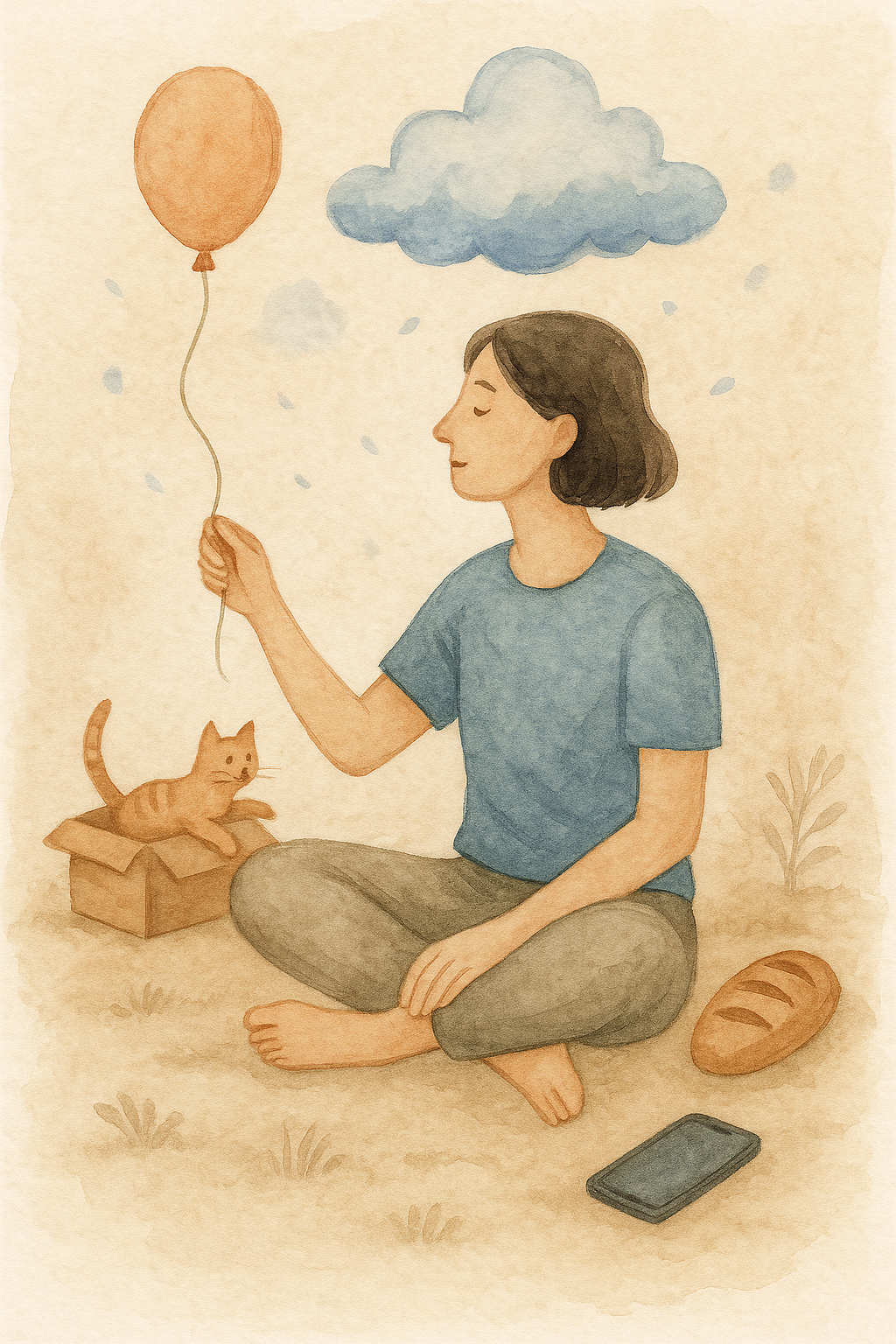
—is the moment life starts showing up uninvited, barefoot, and better than scripted.
It always starts the same way. You’re lying in bed with your phone hovering inches from your face, backlit in ghostly blue, replaying that message thread like it’s a true crime documentary. Every emoji, every punctuation mark—suddenly a clue. Your mind, a CSI unit for emotional chaos. You tell yourself this is the last time. Then do it again tomorrow. Obsessive overthinking is the late-night snack no one talks about, and we keep going back like it might taste different this time.
But it’s not the message or the missed call that’s the real issue. It’s the quiet panic behind it—the lie we buy into that this was our one shot.
One person. One opportunity. One outcome. And now it’s gone.
We act like joy is being handed out in rationed portions, and we showed up too late to the counter.
Meanwhile, toddlers are finding delight in laundry baskets and cardboard boxes.
They’re not chasing scarcity. They’re chasing the cat.
When we believe life is short on what we want, we grip harder. And nothing makes us cling like the fear of lack. That’s how we spiral: not from the event itself, but from the mental math that says this was our only chance.
A bad date becomes proof that love has left the building.
A job rejection morphs into a career obituary.
But then, somehow, we’re back up the next morning, brushing our teeth like nothing happened. Emotional survival is a skill we’ve mastered, even if we’re dramatic about the practice.
And yet, we forget our own history. Every time something didn’t go our way, we declared it the end. And every time, we were wrong. We’re still here—maybe bruised, maybe eye-rolling at the memory—but intact. That should be our proof.
But our ego doesn’t want proof. It wants control.
And when life shrugs at our plans, ego goes full tantrum. The mental equivalent of a toddler at the toy store floor: arms crossed, red-faced, demanding things go back to how they were in its head.
But life isn’t a courtroom where we argue our expectations into existence. It’s more like street theatre. You can try to script your part, but someone in a gorilla suit will inevitably walk through the scene. Learning to let go is less about zen monk wisdom and more about realizing you’re not the director, just a very committed actor in a story that’s co-written by weather, timing, other people’s choices, and traffic jams.
Letting go doesn’t mean you stop caring.
It means you care without turning it into a hostage situation.
You show up, you give it your best, and then—you leave room. Space for what unfolds.
It’s like baking bread. You knead, you shape, but at some point, you have to walk away and let the yeast do its thing. Hovering doesn’t help. In fact, it deflates the dough.
Most of our obsession comes from a place we rarely talk about: not feeling enough.
If we truly believed we were enough, we wouldn’t beg outcomes to validate us.
We’d stop equating attention with worth.
But instead, we attach our value to responses, to job offers, to someone else’s ability to see us. As if our reflection only appears in their mirror.
It’s exhausting. And it’s false.
So what do you do instead?
You get comfortable with discomfort.
You let the craving for validation come without rushing to satisfy it.
You treat it like a craving for sugar—sharp, loud, but survivable.
You build tolerance. The kind of tolerance that doesn’t numb, but fortifies. And yeah, it burns. But so does strength training, and we still do squats for a reason.
If you need a practice, start with sitting still.
No mantras, no incense, no cosmic expectations. Just sit.
With your thoughts. Let them swirl. Meditation isn’t about bliss—it’s about watching your chaos without grabbing a mop. You’d be amazed what calms down when it’s not being constantly prodded.
Detachment isn’t cold. It’s warm and wise.
It’s the confidence that you’ll be okay whether they text back or not.
Whether the plan works out or goes sideways.
It’s refusing to be dragged around by uncertainty like a balloon in the wind.
You’re grounded. You know who you are.
So loosen the death grip. Exhale.
Laugh at how much energy we waste trying to control weather patterns.
You don’t have to force the plot to have a good story.
And here’s a mantra that actually sticks:
Letting go isn’t losing. It’s choosing to stop auditioning for a role in someone else’s idea of your life.
Leave a Reply