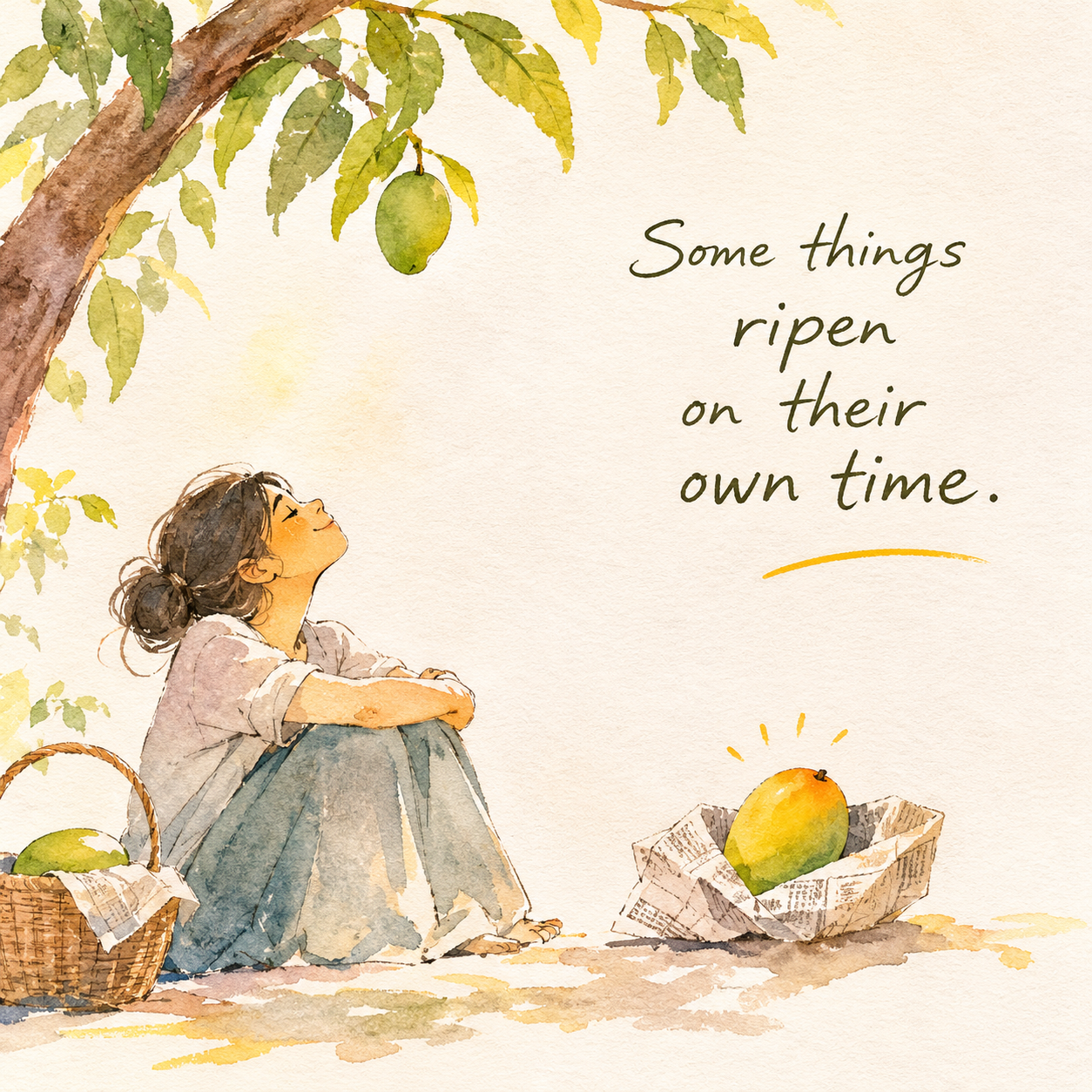
I was standing under a mango tree with a long bamboo pole, glaring at one small green mango that hung just out of my reach, and I was properly angry with it, which is a ridiculous way to feel about fruit. I had made up my mind that it was late. If you had asked me late for what, I could not have answered, but I was holding a timetable in very confident handwriting that said I should be married by a certain age, established by another, and by now a person who never has to wait for anything.
In my head every other mango was already picked, sliced and sitting on a plate, arranged by someone more organised than me. Mine was hard as a cricket ball and almost the same colour as the leaves around it, so I couldn’t even prove the tree had wronged me.
It took three tries to knock it down. I bit into it standing right there in the garden and my whole face folded in on itself like a paper bag. I laughed out loud, by myself, because the sourness was so complete and so well deserved. I had done every part of the job correctly except the one part that mattered, which was leaving it alone.
That timetable is the first clock. It belongs to everyone and to no one, since I have never met the person who winds it. It runs on kind questions at weddings and small comparisons over tea, and it has firm views on when I should be married and how far I should have got by now. Whenever I forced a result onto its schedule, I ended up in the same place, frustrated and oddly helpless, like the woman under the tree complaining to nobody that the fruit is sour.
The second clock only showed itself after the first had worn me out, which is probably the usual order, because exhaustion is often what finally makes a person look up. I can’t read its face or hear it tick and I have no idea what time it keeps. Even so, it seems to be the one that actually ripens things, and in all these years it has never once asked how old I am.
It comes to the surface when love and work slow down together and family politics thicken the air on top of that, until the whole season feels like walking into a room that has gone cold while nobody explains why. My first reading of that is still rejection, and I won’t pretend otherwise, because it turns up faster than any better thought can. Lately I have been practising a second reading, and I say practising because I don’t always manage it: that this is pacing. Seen that way, a delay teaches patience and a bit of self-control, and the people I know who sat all the way through one came out tougher and, oddly, kinder.
I will defend one thing from all this: results come out of processes. Willpower is useful for turning up to the process and hopeless at replacing it. Whenever I try to force a result through effort alone, what ripens is my exhaustion, right on schedule.
There is a mango on my windowsill now, wrapped in newspaper the way my grandmother’s generation did it. Every morning I look at it and nothing seems to have changed, and I have stopped reading that as a verdict.
Yesterday, for the first time, the room smelled faintly of it.
I look forward to your writing – the analogy is spot on ..if only we could leave the raw mango alone to let it ripen in its own sweet time …if only we can turn a deaf ear to the ‘kind ‘ comments of people about the pace of the ripening …. If only we could cover ourselves in layers of newspaper …
Wow Simple yet profoundly relatable. Life lessons through a raw mango.
Vasu you always surprised me .What a writeup with life lessons in so interesting way .I think now you should think seriously about your writeups .So happy to read your writeups .Keep writing .Love you mere bacche .
Your
Maa