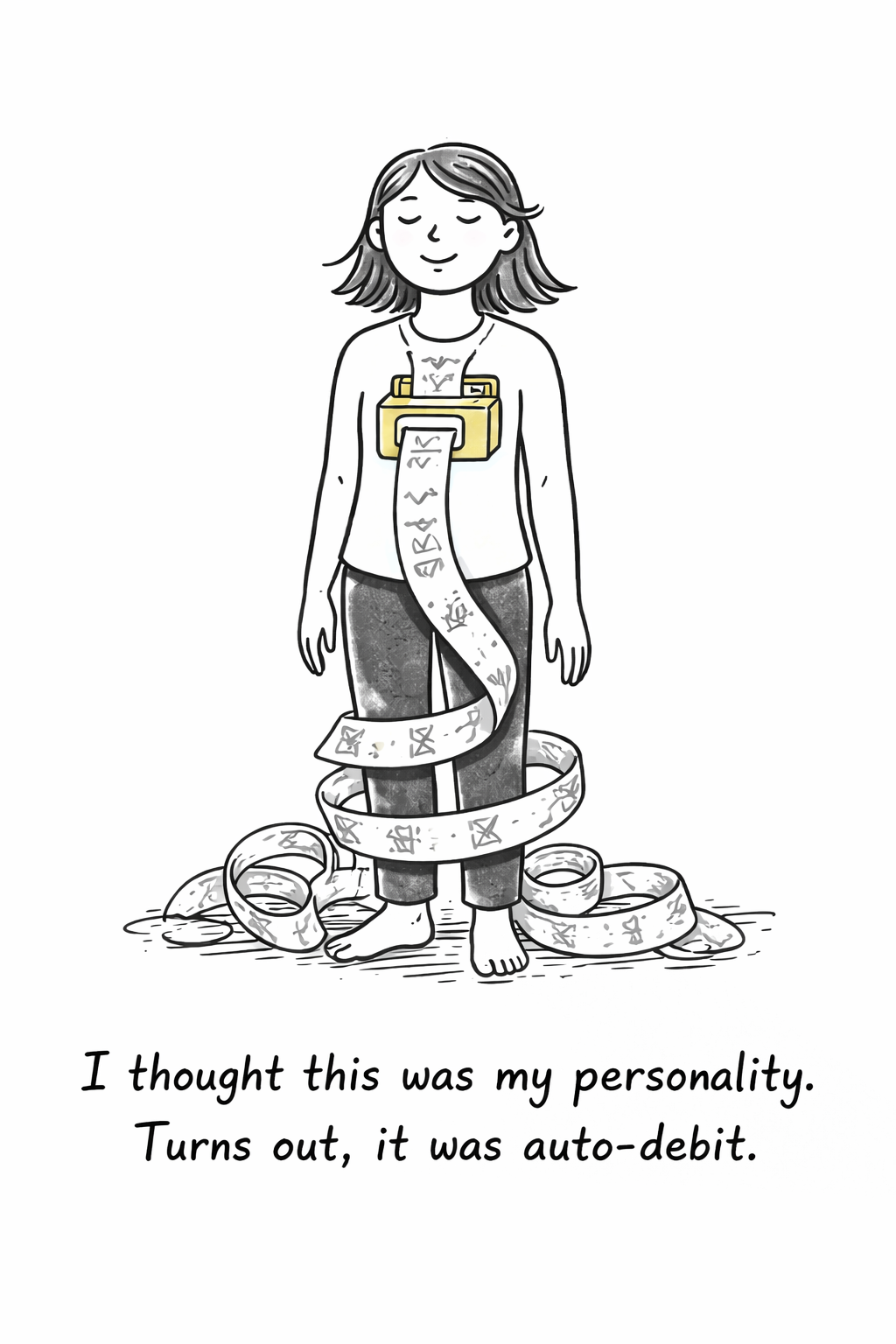
A few weeks ago I was on a call with a friend — someone I trust, someone I’m easy around — and she said something about how I “always disappear when things get heavy.” Just tossed it out between sips of coffee, the way you’d mention that it might rain later.
She wasn’t trying to be cruel. She was being more accurate than I’d been with myself in probably a decade.
I laughed. Said something about being busy. Changed the subject with the smoothness of someone who’s been changing subjects since elementary school, then put the phone down and sat on my floor for twenty minutes doing absolutely nothing, which, as a fully functioning adult woman on a Wednesday evening, is a very dignified thing to do.
I wasn’t crying or spiraling — I was just sitting there with this sensation of having been handed a bill I didn’t remember signing for, and the amount was way larger than expected. Because she was right, and I’d spent years constructing a very convincing alternative story. That I was just independent. Just someone who needs space. Just wired that way. And sitting there, the whole thing started coming apart like pulling a loose thread on a sweater you’ve worn so long you forgot it wasn’t your actual skin.
Who I Am In This
I’m the eldest daughter. If you grew up as one, something in your body just tightened when you read that — a little recognition, a little fatigue. If you didn’t, think of being eleven and somehow responsible for the emotional climate of an entire household — a tiny air traffic controller who also has to get straight A’s, do the chores, absorb everyone’s moods, be the good girl, never complain and look fine while doing all of it. I didn’t apply for that job. I was just assigned.
I’ve been collecting labels my whole life the way some people collect souvenir magnets from vacation.
OCPD. Anxiety. Perfectionism. Overachiever. Imposter syndrome, which I should clarify is less of a phase and more of a roommate who moved in when I was fourteen, contributes nothing, eats my food, and still somehow has opinions about everything I do.
I proofread texts to friends three times before sending.
I get promoted and immediately start a mental countdown to the moment everyone discovers there’s been a filing error.
I can present to two hundred people and then fall apart in the bathroom because someone in row three looked bored.
Functional? Absolutely.
Thriving? That’s where the accounting gets interesting.
The Five Years That Helped and the Layer They Couldn’t Reach
I’ve been in CBT for about five years. Read the books — the good ones, the ones people underline and post to their stories with a latte artfully placed in the corner of the frame. Done the thought records, the cognitive restructuring, the behavioral experiments. CBT gave me a lot and I want to be clear about that — it taught me to catch distorted thinking mid-flight, to challenge the catastrophic predictions my brain produces on an assembly line, to wedge a tiny gap between something happening and me reacting to it.
But something kept humming underneath all of that work, and the humming didn’t care how many thought records I filled out. I could talk myself out of a spiral — I had the tools, I could run the exercise — and my body would still be vibrating at a completely different frequency than the calm my mind had carefully brokered. I’d journal through a trigger and land on “I’m safe, this is fine” and my stomach would still be clenched like it was bracing for a second impact.
My shoulders’ official response to every rational breakthrough was: “That’s great, we’re happy for you, we’re going to stay up near your ears anyway.”
There was a layer that thinking couldn’t touch. And I spent a long time convinced that meant I was doing the therapy wrong, which — if you know anything about OCPD and perfectionism — is such a predictable response it’s almost comedy. Almost.
A couple of weeks ago I started somatic therapy. Two sessions in, which makes me roughly the equivalent of someone who’s been to the gym twice and wants to tell you about progressive overload. But something in those sessions cracked open a door to a room I didn’t know existed, and the reading I’ve been doing around it is connecting dots that five years of cognitive work left floating. What follows is me thinking out loud, trying to make sense of something I’m still standing inside of.
The Loan I Didn’t Sign For
I think every emotion I swallowed instead of feeling became a loan my body took out without asking me, and my nervous system has been making payments ever since — using my energy, my sleep, my relationships, my health, my ability to enjoy a Saturday that has nothing on it.
What I’ve been calling “my personality” might just be the repayment structure.
My impatience, my restlessness, my physical inability to sit through an unstructured afternoon without a to-do list — I wore all of that like merit badges.
Called it drive. Called it ambition.
Optimized my entire identity around being the person who gets things done, who’s always on, who doesn’t need a break.
Turns out I wasn’t driven — I was making payments on something I couldn’t name, running from a creditor I couldn’t see, and I’d been at it so long the running itself looked like personality.
The Closet That Never Got Cleaned Out
The biology underneath this is simpler than I expected, and that’s why it landed so hard.
When something overwhelming happens, your body gears up — muscles tighten, heart rate climbs, chemicals flood, everything gets ready to act.
Think of it the way a dog gets wound up when it spots a squirrel — the whole body mobilized, every muscle coiled, ready to chase. If the dog actually gets to run, it sprints, pants, shakes it off, and it’s done. System resets. Tab closed.
But if you hold the dog back on the leash every single time, that energy doesn’t dissolve — the dog gets weird, twitchy, reactive, starts barking at things that aren’t squirrels.
We’re the dog on the leash.
When you’re a child and something overwhelming happens — a parent’s rage, a humiliation, a betrayal you don’t even have vocabulary for — your body mobilizes the same way. Push back, bolt, scream, crumble.
But a child at a dinner table where a parent is losing their temper can’t do any of those things.
You can’t push back because the threat is the person who feeds you.
You can’t leave because you’re eight and this is your entire world.
You can’t cry because through a hundred tiny incidents you absorbed the message that tears in this household are treated like a crime — weakness at best, ammunition at worst.
So all that mobilized energy just gets held, and the body does what it can — shoves everything into a closet, quickly, messily, with the vague idea that you’ll sort through it later.
Your shoulders pack themselves up near your ears and forget to come back down.
Your jaw develops a clench your dentist keeps asking about.
Your stomach becomes this unpredictable thing that four gastroenterologists have investigated with increasingly expensive equipment, all arriving at the same diagnosis: “Could be stress-related” — which, at those consultation fees, is a very expensive way of saying “we have no idea.”
You never sort through that closet. And over years, decades, the stuff in there starts pressing against the door, warping the frame, leaking into the rooms you actually live in. We call this personality. It’s storage.
The Realization That Rewired My Understanding
My somatic therapist said something in our first session that I keep turning over like a coin I found in an old jacket — she said the body doesn’t store unprocessed emotions as memories, it stores them as states, and the difference between those two things is enormous.
A memory is a photograph you can look at — it happened, it’s behind you, you can talk about it with some distance, the way you’d describe a movie you once saw.
A state is the room you’re standing in. A state is NOW, happening in your current body, in your current apartment, regardless of when the original event took place.
Which is why I can be a competent adult on an ordinary Tuesday, and my partner can sigh with a certain weight behind it — just a sigh, just air leaving his lungs — and in about half a second I’m not a competent adult anymore. I’m a child at a table, scanning for danger, calculating trajectories, trying to fold myself small enough to avoid whatever’s about to happen.
My adult brain knows the difference between my partner being tired and my childhood.
My nervous system couldn’t care less about that distinction — it’s replaying a loop that started twenty-five years ago and never completed, like a song stuck on the same eight bars, forever waiting for a resolution that never comes.
You’re not remembering your past. You’re re-entering it.
I rolled my eyes at the word “triggered” for most of my twenties. Then I felt the loop play in my own body — the full-system hijack where your hands go cold, your chest turns to concrete, and your brain just vacates the premises — and I understood that whatever we’re calling it, the mechanism underneath is as mechanical as a circuit breaker tripping. One that tripped when I was small and nobody came to reset it.
How the Interest Compounds
You know how credit card debt works — you miss a few payments and the minimum goes up, and then the interest starts generating its own interest, and before long you’re paying hundreds a month just to stay in the same place, and from the outside it looks like you’re managing your finances because you’re making payments every month, except all you’re covering is the interest and the principal hasn’t budged in three years.
Your nervous system does the same math.
Every unresolved emotional charge makes it easier for the next one to set you off. Your internal alarm system — the amygdala, if you want the clinical name — recalibrates lower with each one, like a car alarm that’s been bumped too many times and starts going off when a pigeon lands on the hood. Five years ago, a pointed comment from a colleague was just a pointed comment and I’d move on with my afternoon. Today, someone’s slightly cold tone in a voice note can send me into a two-hour internal trial where I’m simultaneously the defendant, the prosecutor, and the jury — building an airtight case for why they secretly despise me, citing evidence from a group chat three months ago.
I kept thinking I was getting weaker. I was getting more indebted — each unprocessed emotion lowered the bar for the next trigger, and the triggers were getting cheaper while I was getting broker.
Each unprocessed emotion made the next trigger cheaper to pull.
And while the alarm system is getting more hair-trigger, the thinking brain — the prefrontal cortex, the part that’s supposed to help you pause and weigh context before reacting — is going in the opposite direction. Those two are basically in a turf war, and chronic emotional activation is like the alarm system hiring more soldiers every quarter while the thinking brain’s budget keeps getting slashed. You become reactive where you were once thoughtful, and you can feel the erosion happening in real time — watching your own judgment deteriorate from the inside — which stresses you out more, which adds to the balance. Compound interest on compound interest, a closed loop feeding itself.
Meanwhile your stress hormones settle into a permanent low-grade elevation — not a crisis siren, more like a light that’s always on in a room nobody’s using. You stop noticing it, the way you stop hearing a refrigerator until someone unplugs it and the room feels like a cathedral. But it’s burning electricity the whole time. Your immune system takes the hit first — you catch everything going around. Then your sleep degrades — you’re unconscious for seven hours but your body never drops into deep restoration, so you wake up feeling like you slept on a conveyor belt. Then memory gets patchy, metabolism changes, and the cumulative effect, according to everything I’ve been reading, is essentially accelerated aging — your body paying a bill your mind keeps insisting doesn’t exist.
I genuinely believe emotional debt ages the body at a pace comparable to a pack-a-day habit, and I think within a generation we’ll have the research to prove it. That’s a big claim from someone who’s been in somatic therapy for two weeks, but the reading keeps pointing in the same direction and my body — the one that’s been trying to get my attention for a decade through every stomach problem and sleepless night and inexplicable bout of exhaustion — seems to agree.
When the Debt Starts Recruiting
The thing about financial debt is it stays in its lane — it’s numbers on a screen, it doesn’t reach into your marriage or your friendships or your sense of who you are. Emotional debt doesn’t have that kind of boundary.
Once the balance gets big enough, it starts pulling everything else into the payment plan. Your relationships become servicing arrangements — you pick partners whose chaos feels familiar because your system is scanning for what it grew up with, the same way your Spotify algorithm keeps recommending songs that sound like what you already listen to. Your career becomes a distraction strategy — staying so busy you can’t hear the hum underneath. Your daily habits — the midnight scrolling, the overcommitting, the way I reorganize my entire apartment at 11 PM when I’m overwhelmed because rearranging furniture is easier than sitting with what’s underneath — those are all interest payments.
The collateral is your identity. Everything slowly reorganizes around the debt until, from the outside, it all looks like personality. “Oh, she’s just intense. She’s driven. She’s a perfectionist.” That’s a nervous system running an entire life on the fumes of a coping strategy that was supposed to be temporary, building everything around staying one payment ahead of default. And the most impressive trick is that it looks, from every angle including the mirror, like a choice. Like a trait. Like something you’d put on a résumé.
The Payment Plans I Recognize In Myself
I scroll. I overwork. I buy things at 1 AM I’ll unbox three days later and think why. I binge shows I won’t remember by the following week. And if I’m being truly, uncomfortably honest — which somatic therapy is slowly and annoyingly teaching me to be — I don’t do any of these things because I enjoy them.
I do them because feeling nothing is cheaper than feeling everything I owe.
Numbing works. That’s the whole trap, and it’s perfectly engineered. Calling it a discipline problem is like calling a mortgage a math problem — technically you’re not wrong but you’re missing the entire structure underneath. The behavior — the scrolling, the wine, the productivity binge, whatever — is the fastest payment method your system has found, and when the alternative is confronting the full balance, speed is everything. Willpower against numbing is bringing a squirt gun to a structural fire.
The debt waits, though. Patient, like any good creditor. It waits for the vacation where your body is on a beach but your chest is buzzing with something you can’t name. The free Sunday afternoon that fills you with a low-grade panic instead of rest. The achievement that should feel like satisfaction but instead feels like you’ve just given more people reasons to look closely at you.
The Performance, the Loneliness, and the Thing I Kept Calling Love
Then there’s performing, and I know this one the way you know a song you’ve heard so many times the words come out before you think them. Being the most composed person in every room, the reliable one, the eldest daughter who was essentially a third parent by eleven, monitoring the household’s emotional weather like a sailor watching the sky while making sure everyone else was okay and running on fumes and calling that normal.
That performance is so deep in my wiring that I genuinely cannot find the seam between it and me. I’m looking. I’m two sessions into looking.
And there’s loneliness that comes packaged with the performance — the kind where you’re at dinner with eight people who care about you and you feel like you’re watching the whole scene through a window, everyone right there and nobody actually knowing you, because the performance is that seamless, running since childhood with such efficiency that nobody thinks to look behind it. Including you.
I thought everyone walked around with that glass between themselves and other people. I thought that was just how being alive felt.
I’m starting to think the glass is debt.
And then there’s what I’ve been doing in relationships, which I’m only now seeing clearly enough to put language around — the over-functioning, the anticipating every need before it’s voiced, the bending into whatever shape makes me indispensable, because somewhere in my operating system there’s a line of code I didn’t write that says: if you make yourself essential enough, you will be kept. I called this love. I called it love for a really long time. It’s a monthly minimum payment in a very convincing disguise.
Because your nervous system doesn’t seek what you want — it seeks what it recognizes, the same way Spotify doesn’t recommend music you should like, it recommends music that sounds like what you already play. If warmth in your childhood was tangled up with chaos, you’ll feel most electric around people who keep you off-balance. If closeness meant someone else had all the control, you’ll walk into domination and call it safety. If affection was always transactional — earned, performed for, traded — you’ll grow up believing the only love that counts is love that leaves you depleted, and the person who offers it freely, without conditions, won’t even register. Like trying to play a file format your operating system doesn’t support.
I’m still catching the pattern mid-loop, which I think counts as progress, even though it mostly feels like watching yourself walk into a glass door in slow motion while a small voice in your head goes “there she goes again.”
The Difference Between a Car Crash and Rust
I spent a while confusing what I’m describing with trauma, and I think most people do, and I think the confusion is expensive. Trauma is an event — a car crash, an assault, a single moment that blows past your system’s capacity to absorb it. You can put it on a calendar. A clinician can code it. You can point to the date.
What I’m talking about is more like rust. A thousand moments where something was felt and never completed, each one so minor that mentioning it feels almost embarrassing. Being furious at ten and discovering that fury in your house was treated like treason. Needing to fall apart at seven and having an adult tell you to be brave, to hold it together, to be the strong one — as if a seven-year-old should be strong about anything other than opening a pickle jar. Being recruited as your parent’s emotional manager before you’d learned long division, mediating their arguments, reading their moods, absorbing their stress while also having homework due.
There’s no clinical code for any of that. “My mother once told me to stop crying at a family gathering” would sound trivial in a therapist’s intake form. But stack a thousand of those moments across twenty-five years, each one leaving a thin film you can’t see or name —
That erodes a life more effectively than most catastrophic events, because you can’t see it. You just feel the weight and assume it came with you, like a factory setting.
My parents did their best. I believe that completely, and I’m not performing generosity when I say it — they were underwater in their own compound interest, passing forward a balance they didn’t know they carried. You can’t transfer wealth that was never in your account. The ledger just moved, generation to generation, like a family heirloom nobody asked for and nobody knows how to return and nobody even realizes they’re holding.
And I think emotional systems have a bankruptcy threshold, the same way financial ones do — a point where the minimum payments can’t cover the interest and the whole structure folds. That’s what people mean when they say someone “had a breakdown,” which always bothered me because it implies a malfunction, like the person was an appliance that stopped working. The math is less interesting than that — all the coping mechanisms and performances and numbing strategies that had been keeping the structure upright just stopped being enough, all at once, on a random Thursday. The balance exceeded the system’s capacity and the account defaulted.
The Cure and Why It’s So Cruel
I’ve been reading about what actually seems to work — therapy, breathwork, meditation, cold exposure, psychedelics — and the interesting thing is they all seem to do the same thing at the mechanical level, which is reposition you. They move you from being inside the experience to being able to observe it from somewhere outside, even if it’s only an inch outside. The way you can’t read the label on a jar you’re sitting inside of.
And I want to be careful here because it’s easy to hear “perspective” and think I’m talking about look on the bright side, others have it worse — that’s comparison wearing a wellness costume. I mean something more like what a surgeon needs: you have to be standing outside the body to operate on it.
CBT gave me cognitive tools and I value them and I’ll keep using them, but two sessions into somatic therapy I’m beginning to sense something CBT couldn’t access — my body has been holding an entire conversation I wasn’t invited to, and the only way to hear it is to feel it, which is the one thing my entire system was engineered from childhood to prevent. The very architecture that protects me from drowning is also the architecture blocking the swimming lesson. My therapist probably has a more elegant way of putting that but I’m two sessions in and still mostly thinking in my own metaphors.
Therapy works when you say something out loud and hear it from outside yourself, maybe for the first time — you’ve been inside a narrative for two decades and suddenly you’re holding it at arm’s length instead of wearing it. Meditation does something similar through sustained attention. Breathwork does it by pulling you from your head into your body, which sounds like a bumper sticker but is actually a neurological event. Cold exposure — which I haven’t tried but keep circling — apparently teaches the nervous system that a racing heart can mean something other than danger, which would be groundbreaking news for a system that’s been treating every elevated heartbeat as a five-alarm fire since 1998.
And these are all tools that have been around for thousands of years — our brains haven’t changed in 200,000 years, and I find it both humbling and a little funny that we got so confident a pharmaceutical company was going to outsmart civilizations that figured out astronomy with their naked eyes and built structures we still can’t reverse-engineer.
The cruelest piece of the whole thing is that the debt actively prevents you from accessing the one thing that could resolve it. The numbing, the busyness, the performing, the over-functioning — all of it works as a shield against this repositioning. The system protects itself from its own cure, which is so perfectly ironic it feels like it was designed by a screenwriter with a grudge — like a body rejecting an organ transplant, thank you, this is exactly what I need, and I will fight it with everything I have.
Which is why telling someone in massive emotional debt to “just feel your feelings” lands about as well as telling a friend who just discovered they owe six figures to “just open a savings account.” Technically correct, operationally useless, and honestly a little insulting.
What I’m Trying (and What I Mostly Don’t Understand Yet)
I should be upfront that most of what follows is guesswork informed by reading and by the very early experience of having my therapist say things that make my body respond before my brain can form an opinion about them.
The first thing that’s been useful — and it sounds so simple it’s almost irritating — is that I started seeing my own patterns as payments, the way putting on glasses doesn’t change the world but changes your ability to read it. A colleague makes an offhand comment and my entire evening craters, and instead of spiraling into why am I like this, what’s wrong with me, I’m too sensitive — which is where that loop always went — I can now think that’s a payment. The rest doesn’t feel threatening because rest is dangerous, it feels threatening because my system can’t tell the difference between resting and the vulnerability that was unsafe when I was small. The inability to be in a room without stimulus isn’t a preference, it’s an avoidance of something I’m not ready to sit with yet, and even that framing — not ready yet instead of broken — changes the math somehow.
I don’t need to know what the original event was and I could have amnesia for my entire childhood and this would still work, because I’m reading the payments, which are happening in real time, right now, in my current body. The story of what happened is less useful than the ledger of what I’m still paying.
The Sticky Note On My Mirror
The second thing I did was write down my go-to coping strategy on a sticky note and put it on my bathroom mirror, which felt absurd — genuinely, I stood there looking at my own handwriting saying “performer and over-functioner” and thought this is either the beginning of something or the most middle-class cry for help of all time.
But seeing it written in my own hand, in a place I look at every morning while I’m still half-asleep and my defenses haven’t fully booted up — it created a gap between me and the behavior that wasn’t there before. Because “holding everything together for everyone” isn’t who I am, it’s a strategy I’m running, and the moment I could see it as a strategy — the same way you suddenly notice the music in a retail store is designed to make you buy things — the whole routine started to stumble. I’d be mid-performance, doing the thing where I make everyone comfortable and absorb all the tension in the room and broadcast that everything is completely fine, and this small voice would go oh, there she goes, and the whole thing would hiccup for a second.
It doesn’t stop. It hiccups. But there’s something in that hiccup — some tiny space that wasn’t there before — and I think that’s where whatever comes next is going to live.
The Body Wants to Finish What It Started
The third thing is the one I understand the least and can speak to the least honestly because I’m mostly working from books and articles and things my therapist says that I frantically type into my phone the second I leave her office like a student cramming for an exam.
From what I can piece together, the charge stored in the body is an incomplete physical response — a motion that mobilized and got frozen mid-gesture because completing it wasn’t safe. Think of it like yanking a steering wheel mid-turn — the car doesn’t just straighten out, it holds that torque in the frame, and over time the alignment is off, the tires wear unevenly, and you’re compensating with every drive without realizing the original jerk is still in the chassis.
The body apparently needs to finish that motion to release it — physically, literally, through the muscles and the breath, through shaking and tremoring and sometimes crying that has no story attached to it, just sensation moving through tissue until it burns off. Neurogenic tremors is the term I keep encountering, the body’s own built-in discharge valve, something humans have been doing for millennia before someone trademarked it and built a certification industry around it.
I haven’t experienced this yet, and I’m reading about it with the same mix of fascination and nervousness I’d bring to reading about bungee jumping — that sounds transformative and also I’ll let you know once I’ve actually stepped off the platform. But five years of thinking about my patterns, as valuable as that was, left a whole layer untouched, and I can feel that layer humming under every cognitive breakthrough like a bassline under a melody, and I’m increasingly suspicious that the bassline is the thing actually running the song.
Everything I’ve read says you can’t do this work from inside the activation — from inside, it’s just re-drowning with a therapy vocabulary. You need to be close enough to feel what’s moving through you and far enough to watch it pass, which my therapist calls the window of tolerance and which I think of as the distance between this is happening to me and I can see this happening. Breathwork apparently widens that window. Vagal toning widens it. Cold exposure widens it. I haven’t tested most of this, but something below my thinking layer — something my body seems to understand better than my brain — trusts it, and I’m learning to pay attention to what my body trusts even when my mind is still drafting pro-and-con lists.
Trying to Stop Borrowing More
The fourth thing is maybe the hardest for me because of who I am and how I was assembled — I’m trying to stop taking on new debt. Every time I swallow something instead of letting it register, every time I say “I’m good” when something in my chest is clearly communicating otherwise, every time I steamroll past a signal from my body because the to-do list is longer than my patience for self-awareness — that’s another loan on the pile.
I’ve started doing this embarrassingly simple thing where I give whatever I’m feeling ten seconds of attention. I don’t analyze it or journal about it or try to mine it for meaning. I just let it exist for ten seconds, which sounds like nothing but is actually wildly uncomfortable for someone whose entire coping architecture is built around intercepting feelings before they fully form and converting them into productivity.
What I’m noticing, though, two weeks into this experiment, is that when my system starts learning that emotions are allowed to show up without being reorganized or weaponized into a to-do list, it seems to grip a little less tightly — the way a body that’s been hoarding every calorie starts to release once it trusts that meals will keep coming.
The Witness
And the last thing — the one I’ve done the least with and think about the most — is the idea of having someone simply be present while you process, without trying to manage the moment.
Because almost all of my emotional debt accumulated while I was alone with something too big for me, even when other people were in the room — especially when other people were in the room, because the eldest daughter’s whole job is to look fine so everyone else can afford to fall apart. A huge portion of what my body still holds, I suspect, isn’t the emotion itself but the isolation it was marinated in — the aloneness wrapped around the feeling like cling film, preserving it perfectly for decades.
And I have this barely-formed hunch that having another human being simply remain — without advising, without reframing, without flinching, without reaching for a solution the way you’d reach for a fire extinguisher — might reach something that thinking and journaling and even across-the-room therapy can’t quite get to. I’m aware that describing what I need while simultaneously being the person who’s spent thirty-four years making sure nobody ever sees her need anything is its own very particular comedy.
But the isolation is a weight I can feel even when I can’t name what’s underneath it, and I think having someone just stay — the way you’d sit next to someone on a park bench, both of you watching the same pigeons, comfortable enough in the silence — might be the thing that closes a loop that’s been open since I was small. I’m hoping some version of that at thirty-four, late and imperfect and probably awkward, still counts for something.
Why I Wrote This
I wrote this because I’m starting to see the payments for the first time, and because I think a lot of people are making them without knowing what they’re paying for — calling it stress, calling it aging, calling it “just how I am” — and because the most useful thing that’s happened to me in the last few weeks isn’t a technique or a framework but the simple act of looking at my own patterns from slightly above instead of from inside, the way you can finally read a map once you stop walking and hold it at arm’s length.
I was so embedded in the repayment structure that I thought it was my personality. The performance was me. The tension was temperament. The glass between me and everyone else was just how vision worked.
I’m the eldest daughter who was so good at holding everything together that I confused the slow-motion collapse for normal life — servicing a debt I inherited before I could write my own name, making payments so efficiently that nobody, including me, thought to question what they were for.
The debt isn’t the problem. Where I was standing while carrying it — so deep inside the repayment structure that I couldn’t see its walls — that was the problem. And I’m figuring out that you don’t have to pay it all off to feel the difference, you just have to step back far enough to see the ledger.
You go from what’s wrong with me to what do I owe to how do I start paying this down, and I’m somewhere around the first question, maybe leaning into the second on good days, and that feels like enough for right now — which, if I’m being honest, might be the first time I’ve said “enough” about anything and meant it.
Leave a Reply