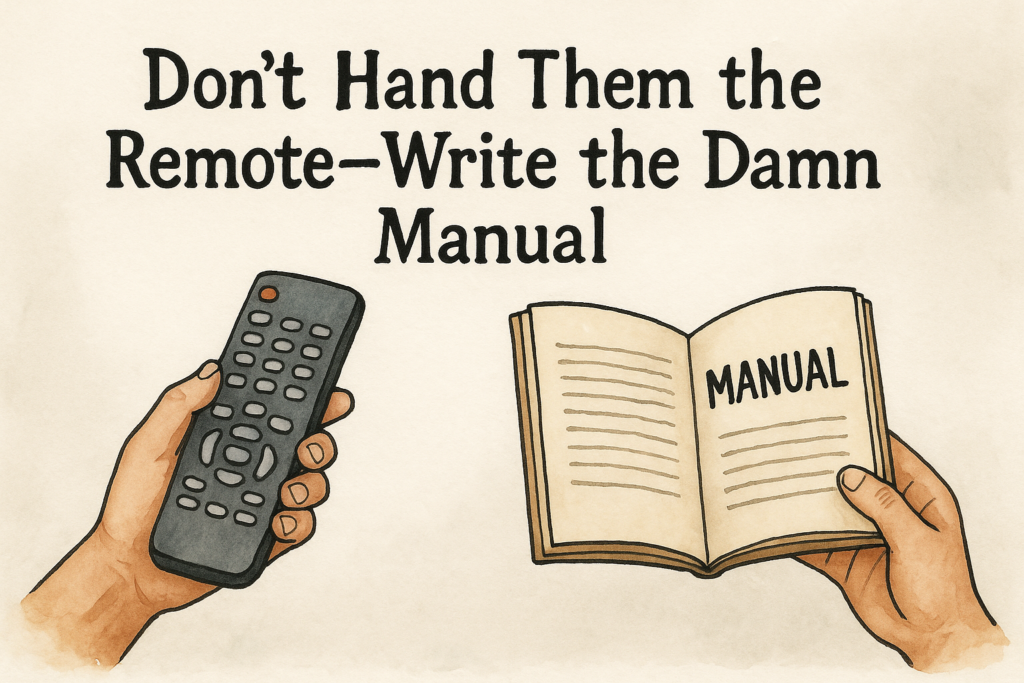
Every relationship has an operating system—spoken or unspoken.
Some people move through the world expecting others to adapt to their rhythms.
Others over-adapt, constantly shape-shifting to avoid tension.
I used to fall into the second category. I wanted people to like me, understand me, get me without explanation.
When they didn’t, I felt slighted. Misunderstood. Invisible.
Eventually, I realized my emotional state was being dictated by everyone except me.
That’s when I started writing a mental manual.
Not for others, but for myself.
If I knew what I needed—what triggered me, what calmed me—I could communicate better. I could protect my energy instead of constantly repairing it. I started setting clearer boundaries, making firmer requests, and recognizing when I was about to abandon myself just to avoid discomfort.
It helped. A lot.
But like any system, it came with trade-offs.
The more structured I became, the more I filtered real life through a rulebook. If someone didn’t respond “correctly,” I felt thrown. If they didn’t speak my language of emotional nuance, I assumed they didn’t care. In trying to avoid pain, I made connection conditional.
Eventually, I learned to hold both.
You can know your triggers and stay open to people who are still learning how to navigate them.
You can set boundaries and allow for mistakes.
You can teach others how to treat you without demanding perfection from the start.
Boundaries matter. But so does flexibility.
Here’s how I apply this now:
- When I feel the urge to retreat after a miscommunication, I pause and ask: “Have I clearly expressed what I need, or am I expecting them to guess?”
- When someone crosses a line, I check:
“Was this malicious—or just unfamiliar?” - When I feel misunderstood, I remind myself:
“Understanding takes repetition.”
The manual is still useful. But I don’t hand it out like a rulebook anymore. I let it evolve. I rewrite it as I grow. I treat it like a conversation—not a contract.
The goal is not to avoid discomfort at all costs. The goal is to stay rooted in who you are while staying connected.
Structure without rigidity. Openness without collapse.
That’s the work.
Leave a Reply