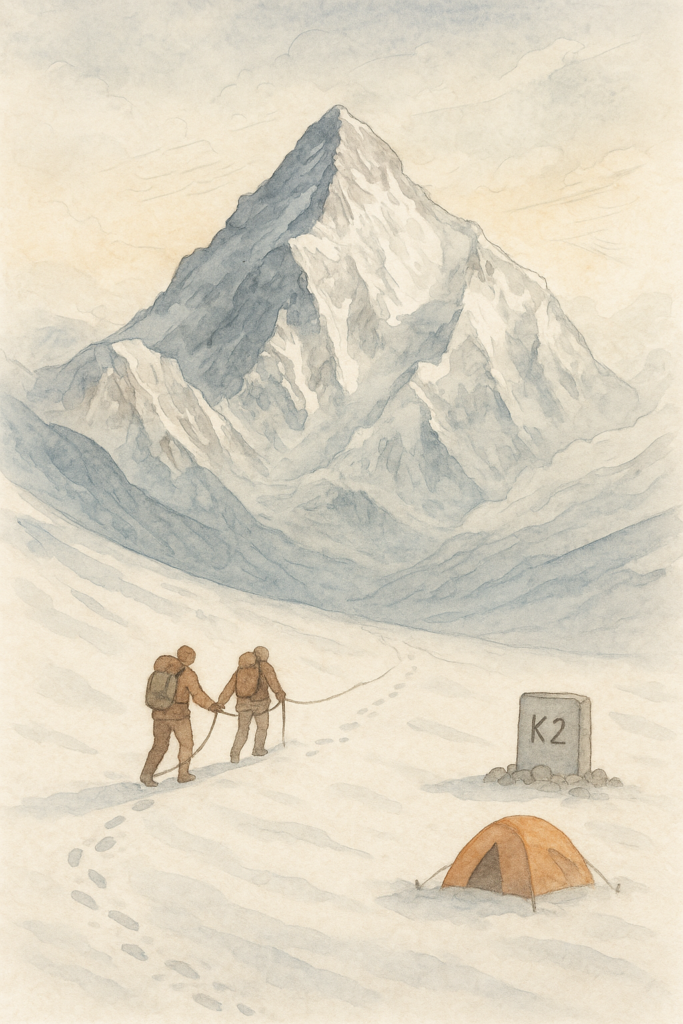
K2 doesn’t care how badly you want it.
That’s the first thing you notice—not in words, but in how it doesn’t flinch.
While other peaks may reward confidence, K2 waits for you to prove your humility. It’s a mountain that strips away ego and leaves only what’s necessary.
When I sat down to watch Ghosts of K2, I expected the usual footage: crampons, summit flags, climbers hugging above the clouds.
What I got instead was a quiet reckoning. Not just with the mountain, but with the human condition itself—ambition, fear, loyalty, and failure, all bound by rope.
The story doesn’t open at the summit. It begins at a memorial. A lonely slab of stone tucked into a windswept ridge in the Karakoram, carved with names of those who didn’t return.
It’s not there to inspire. It’s a receipt for every dream the mountain kept.
The 1939 expedition led by Fritz Wiessner was the first American attempt on K2. What it had in spirit, it lacked in cohesion. The team fractured under stress—disagreements, altitude sickness, and growing distrust among men who hadn’t truly tested one another before stepping onto a glacier together. And then there was Dudley Wolfe.
Wolfe wasn’t a professional climber. He was a wealthy adventurer with more will than experience. And yet, when stronger teammates turned back, Wolfe climbed higher.
Stubborn? Definitely. Reckless? Maybe.
But there’s something painfully human about his insistence. He was trying to outrun something—failure, maybe. Or heartbreak.
He stayed on the mountain even after it became clear no help was coming. Sherpas reached him twice. Tried to lead him down. On the third attempt, three of them disappeared along with him. Their bodies were never recovered. Wolfe didn’t fall in a dramatic avalanche. He simply faded into the snow, and with him, a version of ambition that mistook perseverance for wisdom.
Fourteen years later, in 1953, Charlie Houston returned to K2 with a different vision. His team wasn’t the strongest on paper, but they trusted each other. They trained not just for climbing, but for patience, for decision-making, for decency under pressure.
They were just a few days from a summit bid when Art Gilkey, one of their own, collapsed. A blood clot in his leg threatened his life—and theirs. Houston made the call. No summit. They’d try to bring Gilkey down.
It was a decision that went against everything the sport often glorifies. There was no guaranteed reward. Just snow, cold, risk. They strapped Gilkey to a stretcher made of ice axes and rope, and they began the impossible.
Somewhere along the way, they all slipped. Seven men, tied together, fell. Only one, Pete Schoening, held the line. He wedged his axe behind a rock, used his body as anchor, and somehow stopped what should’ve been seven funerals.
Gilkey didn’t survive. When they went back to his tent, he was gone.
Maybe an avalanche. Maybe a decision. Maybe he stepped away so the others wouldn’t have to carry the weight—his body, or the guilt.
In 1954, the Italians arrived with military precision.
Oxygen. Strategy. A summit plan built like a war map.
They reached the top. They made history.
But their success, clean and efficient, didn’t stay with me.
What lingered was not the achievement but the sacrifice.
Not the peak, but the pause.
The moment someone said, “We won’t go higher, because one of us can’t.” That doesn’t make headlines. But it makes meaning.
I walked away from Ghosts of K2 thinking not about climbers, but about people. About how we measure value—not by elevation, but by elevation of spirit.
Here’s what K2 taught me:
- The top isn’t the only goal. Sometimes turning back is the bravest move.
- Strength is not who gets there first. It’s who holds the rope when everyone’s falling.
- Glory fades. But how you showed up—that lasts.
K2 doesn’t test your limits. It exposes them.
It doesn’t punish weakness. It punishes arrogance.
And it never promises anything in return.
The mountain doesn’t cheer. It doesn’t explain. It just watches.
So the real question is:
When the noise dies down, and the path you planned disappears under ice and silence, who are you then?
Will you still move forward, even if it means carrying someone else?
Even if it means walking away from the very thing you wanted most?
That’s not just a climbing question.
That’s the question at the heart of being human.
Leave a Reply