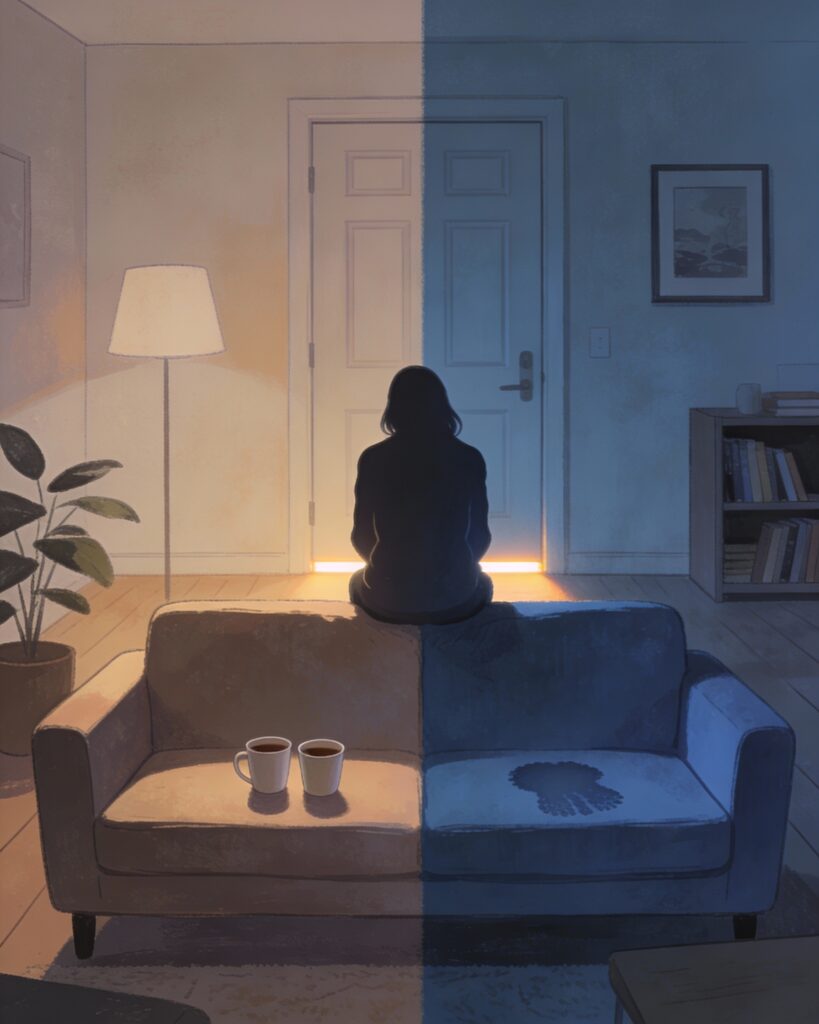
There comes a point in a relationship when the body knows before the brain does.
You don’t break down because love runs out. You break down because staying costs too much of who you are.
We don’t talk enough about that.
How adults quietly start disappearing inside relationships that were once supposed to be safe.
How affection becomes a negotiation, conversation turns into translation, and vulnerability starts feeling like an unpaid internship.
You keep doing the emotional labor long after you stop believing it will matter.
Just to keep the peace. Just to keep belonging.
And then one day, the math stops adding up.
That day rarely looks cinematic. Sometimes it’s the sound of your own sentence landing differently:
I’ve lost my own respect in the process.
You say it out loud, not as a threat, not as an accusation, but as a truth. Something snaps into place.
It’s not that people suddenly stop loving each other. They just stop being able to love in the same language.
One person tries to connect through feelings; the other tries to survive by hiding them.
One sees talking as intimacy; the other sees it as interrogation.
Both are trying to help themselves—but in opposite directions.
You can spend years believing that if you just explain better, compromise deeper, or love harder, things will change. But here’s the painful twist:
Love doesn’t always incentivize growth.
Sometimes it cushions avoidance.
Sometimes it teaches two people to stay sick in complementary ways—one addicted to fixing, the other addicted to fleeing.
Eventually, you stop asking what went wrong and start noticing what stayed the same.
The same silence after every fight. The same exhaustion that follows every reconciliation.
The new routines that feel suspiciously like the old ones. The illusion of progress masking emotional inertia.
People tell you to communicate.
But what happens when you already did, for years, and the problem isn’t misunderstanding—it’s mismatch?
What happens when both people are acting out their childhood defenses in real time, hoping the other will someday become fluent in their pain?
That’s when you realize something terrifying and freeing at once:
you can love someone completely and still be unwell inside that love.
The hardest part isn’t walking away. It’s surviving the quiet after. Because nobody tells you
how to attend a wedding alone,
how to lie through holiday dinners,
how to keep a straight face when people ask how’s everything going.
It’s the pretending that makes healing heavy.
But the strangest kind of pride creeps in, too.
The day you finally refuse to participate in your own erasure, something ancient inside you exhales.
You stop calling endurance devotion. You stop mistaking peace for silence.
You start realizing that leaving doesn’t always mean rejection.
Sometimes it’s reunion — with yourself.
Healing after that isn’t glamorous. It’s brutally mundane.
It means waking up every day and re-deciding not to crawl back into the familiar shape of pain.
It means letting fantasies die slow deaths — the ones where they come back transformed, where you get the apology scene, the closure arc.
It means making plans you can’t emotionally “crash” from:
a walk, a single meal, a small task that proves your life can move without collapsing into the past.
You start realizing that boundaries aren’t walls; they’re altars. The moment you enforce them, you feel both grief and relief.
You’re not punishing anyone. You’re protecting what’s left of your humanity.
Most people think the hardest part of heartbreak is losing the person. But it’s not.
It’s losing the version of yourself you built to keep the relationship alive.
And reclaiming that self — slowly, clumsily, with dignity and doubt coexisting in the same breath — might be the most honest thing an adult ever does.
Leave a Reply