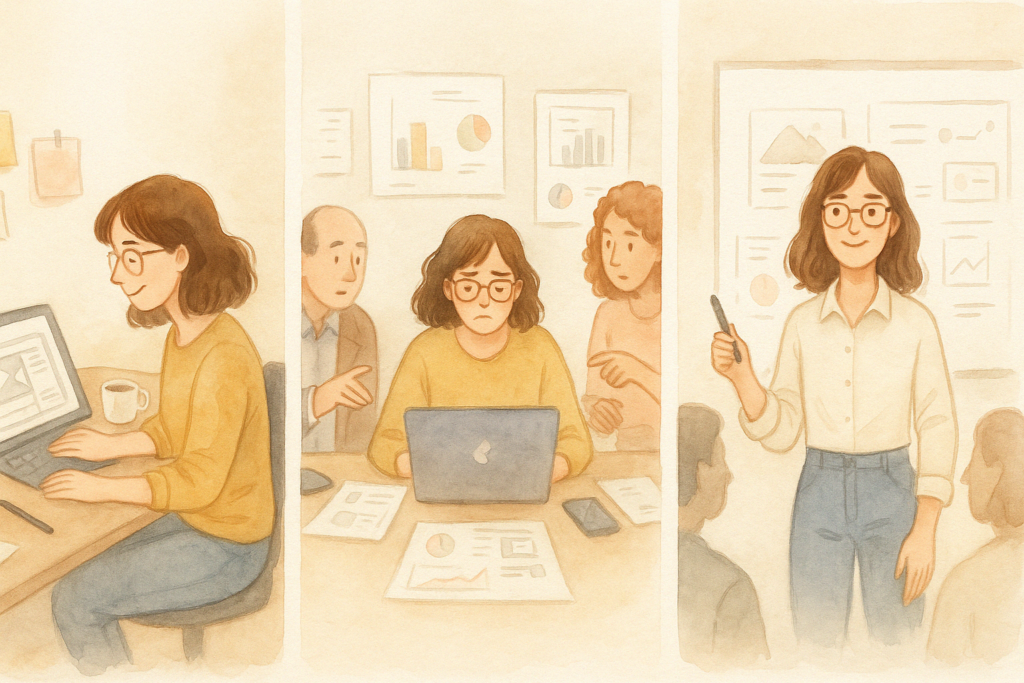
When Bramble—a tiny, pre-seed climate fintech startup—hired Mira, there was no “design org.” No onboarding. No system. No existing anything.
There was just Mira. One designer. One product with more bugs than logic. One request from the founder:
“Can you make it feel like we know what we’re doing?”
She was given a Figma login, a Notion doc filled with contradictions, and a terrifying amount of freedom.
And it was electric.
In those early months, Mira moved fast. Not the “move fast and break things” kind—this was quieter, more personal. A kind of deep creative rhythm that only comes when there’s no audience, no politics, no roadmap pretending to be a map.
She didn’t present her work; she pushed it.
She didn’t ask for alignment; she trusted her gut.
Her reviews were a Slack emoji and a green light. Her process? Solve the problem and move on.
There was no time to second guess herself.
Which meant: she didn’t.
And for a while, her designs were full of weird, beautiful decisions that didn’t need justification. Just a feeling. And that was enough.
Until it wasn’t.
Six months later, Bramble raised $3 million.
And with the money came people.
Product managers. Ops leads. A fractional CMO. A very opinionated “brand guy” from a marketing agency who didn’t know what kerning meant but had strong feelings about “vibe.”
Suddenly, the work that once felt intuitive started needing explanations.
“Why this layout?”
“Can we validate that choice?”
“Will users get it?”
And just like that, Mira’s job shifted from making things… to making things make sense.
She found herself writing documents instead of drawing. Rewriting Slack messages to sound more agreeable. Preempting questions before they were even asked.
It wasn’t the work that changed. It was who it was for.
No longer for the user. No longer for herself.
Now, it was for the room.
This is the part no one warns you about when you become the first design hire.
At first, your power is your autonomy. You are the sole custodian of taste. Speed. Craft. Chaos.
But when the company grows, your value starts being measured in your ability to explain.
Not just to do. Not just to feel. But to package what you know in a way that makes everyone else comfortable.
Mira didn’t resent it—at first.
She leaned into it. She tried to be generous. Accessible. Helpful.
But then she noticed something subtle:
Her ideas got safer.
Her explorations got shorter.
Her gut got quieter.
Until one day, she pushed a design that was fine.
Clean. Uncontroversial.
It got approvals. No questions.
And Mira stared at it for a long time, knowing it wasn’t bad… but it wasn’t hers anymore.
Then came Kriti.
Bramble’s second design hire. A junior from a bootcamp. Nervy, fast, unfiltered. She made sloppy files, broke the grid without apology, and committed cardinal sins like… using shadows. But her work had soul. And she could talk about it.
Not in strategy speak. In feelings.
“This transition should feel like gently closing a book. Not slamming a drawer.”
“This yellow’s a risk, but it makes the page feel like a high-five.”
And something wild happened:
People listened.
They got it.
Even the PM who once suggested Mira change a font because it “felt too ambitious” nodded in approval.
Mira was stunned—not by Kriti’s talent, but by her permission. Kriti hadn’t yet learned to be afraid of overexplaining. She didn’t shrink herself. She stood by the work because she remembered something Mira had forgotten:
Design isn’t just about defending decisions. It’s about carrying a point of view.
Here’s what Mira didn’t learn in design school, or in the job description, or in any design podcast:
- Being the first hire is not about proving your range.
It’s about protecting your rhythm. - You will be asked to justify things that shouldn’t need defending.
Fight the impulse to explain your magic into oblivion. - Process is necessary. But process without permission to play is just project management.
Don’t let your instincts drown in bullet points. - Translation is part of the job. But when you stop speaking in your own language, your work stops being yours.
Today, Mira leads a team of five. She builds in bursts again. Not because she’s back in the early days, but because she’s created conditions where her designers don’t fear being misunderstood.
They share rough ideas without pre-apology. They speak plainly, and design boldly. She tells them to “go weird first, explain later.”
And she means it.
Because Mira learned what most early designers don’t:
Your role isn’t to be the best explainer in the room.
It’s to keep the room curious enough to not need one.
And if you’re ever lucky enough to be the first hire, remember this:
Yes, your job is to ship the work.
Yes, your job is to collaborate.
Yes, your job is to scale the team.
But more than all of that—your job is to not lose your fire.
Because startups grow.
Teams get louder.
And design, if you’re not careful, becomes more about consensus than courage.
Don’t let that happen.
Hold your voice.
Hold your gut.
Hold your space.
Because that’s the one thing no one else can design for you.
Protect the magic—and translate it, too.
Leave a Reply