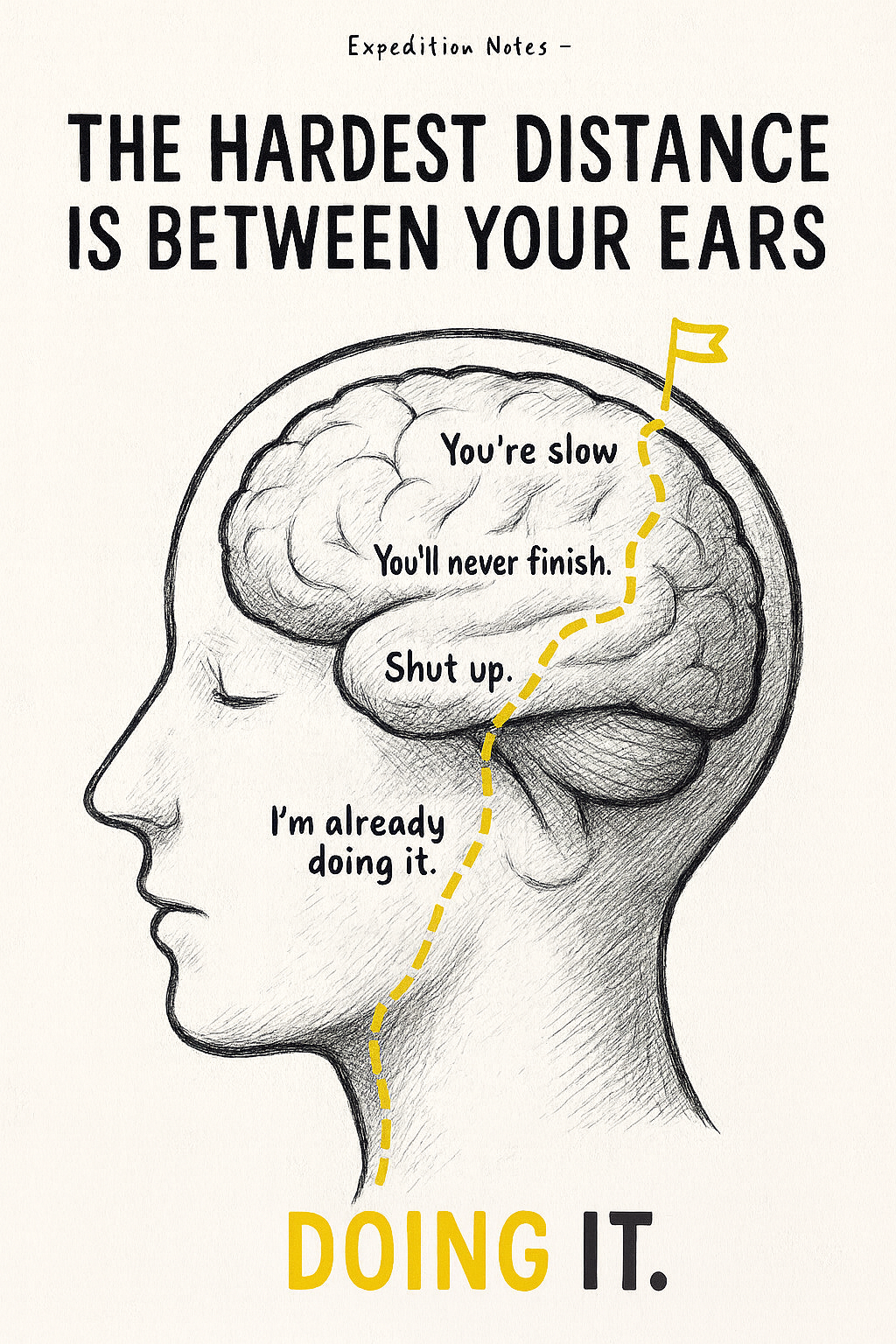
There’s a moment that arrives in every run when my brain starts whispering.
Why are you doing this? You’re not even a runner.
You’ll injure yourself again. You’re not capable of this.
And every single time, I want to stop.
What’s strange is that my body doesn’t even feel tired yet. My legs are strong. My breath is steady. But my mind—oh, it stages a full-blown protest.
The kind where logic and fear join hands and stage a dharna in your head.
I remember the first time I signed up for a Himalayan trek. I was insecure, unfit, unsure. And yet, somehow, I made it to the Chandrashila summit.
On that climb, I was the dead person walking, every step a mental negotiation. My body had given up hours before, but my mind refused to let me quit. That stubbornness carried me through.
That was the moment I realized: I may never be the fastest, the strongest, or the most graceful—but my mental resilience is my secret engine. It’s what lets me survive snow, rain, sleepless nights, upset stomachs, and altitude sickness alike.
But running is a different beast. Physically, I’ve grown stronger. I can keep pace, my muscles hold, my lungs pull air efficiently.
But my mental chatter is relentless. Every kilometer, my brain reminds me of my limitations. And I cave, long before my body even flinches.
It’s a peculiar contrast.
On treks, I’ve seen my body fail me, but my mind carry me.
On runs, my body is ready, but my mind is the traitor.
I’ve learned that endurance isn’t just measured in kilometers or calories burned.
It’s measured in the moments you fight the voice inside your head that begs you to quit. That’s the real distance.
I’ve also learned how small things can tip that scale. A shared glove, a word of encouragement, someone waiting for you for just a few seconds — these moments breathe life into the tiredest of limbs. And sometimes, that’s enough to push forward, long past what seems humanly possible.
Trekking has an external enemy: altitude, weather, terrain.
You fight something visible.
But running is just you and your thoughts in a loop.
No view to distract you, no summit to chase.
Just the raw conversation between who you are and who you pretend to be.
During a run, my inner critic becomes a full-time commentator:
“You’re slow. You look ridiculous. You’ll never finish.”
And I start believing her. That’s the real exhaustion —
Believing your own nonsense before your body even gets the chance to prove otherwise.
Lately, though, I’ve started noticing something.
My body can handle more. It’s my mind that hasn’t caught up.
The same legs that carried me through Himalayan blizzards can easily carry me through a 5K. But somewhere between kilometer two and three, my head convinces me to quit.
And maybe that’s the real training I need—to stop negotiating with that voice. Because strength isn’t built in your muscles first.
It’s built in the moment you refuse to listen to the part of you that’s scared.
I’ve met people who crumble in the cold but thrive in chaos.
People who can lift twice my body weight but can’t handle a rainy day.
We all have our breaking points, but some of us have just learned how to dance with discomfort.
That’s what I’m trying to relearn.
To stay when it sucks. To keep moving when the voice gets loud.
To remind myself that misery is not a sign to stop—it’s the ticket to transformation.
The truth is, pain isn’t proof that you’re weak.
It’s the sound of your limits arguing with your potential.
And I’m done letting the voice win.
Next time she starts—you can’t do this, you’re not a runner—
I’ll tell her what I told myself at 13,000 feet in a snowstorm:
“Shut up. I’m already doing it.”
The real distance isn’t on the road or the trail
—it’s between your ears.
Leave a Reply