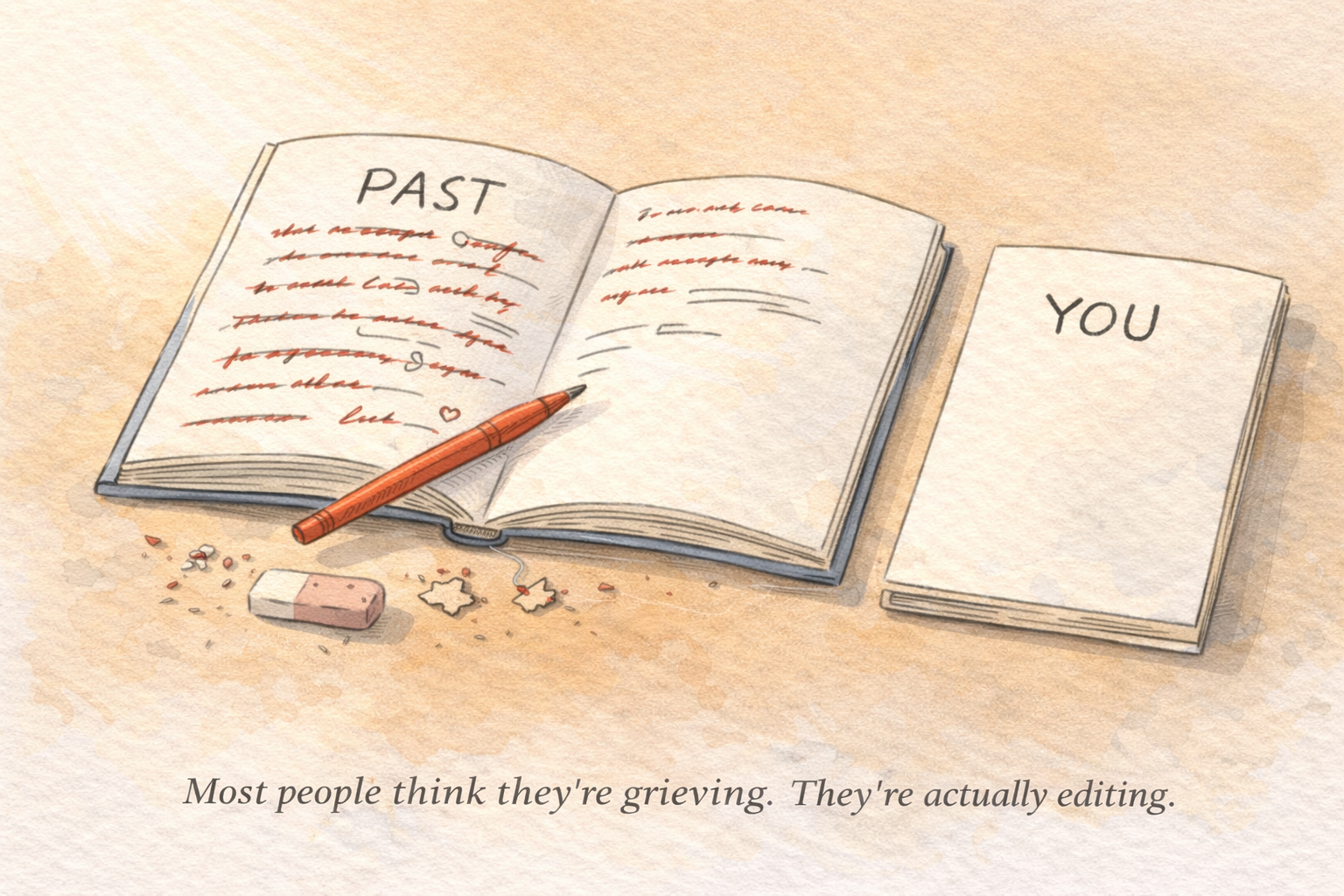
There’s a version of the past that lives in you like a book you’ve already finished but keep rereading, and the honest reason you keep returning has very little to do with the ending — which you already know — and everything to do with the fact that being inside the story feels safer than standing outside it with nothing to hold.
Grief moves through you and releases. What most people are doing instead is maintenance — the daily, largely unconscious act of keeping a version of events alive, tending to it, making sure the details stay sharp and the meaning stays intact.
The distinction matters more than it seems.
Your Brain Is Running Autocomplete on Your Life
Psychologists call this the “narrative identity trap.” You are the story you tell about yourself, and the moment that story gets threatened, your brain treats it like a survival emergency — same neural pathways, same cortisol spike, same fight-or-flight that activates when a car cuts you off at speed. The brain genuinely cannot distinguish between a threat to your body and a threat to your self-concept, which is why people will argue for hours defending a version of events that is clearly making them miserable.
The story isn’t just what happened to you. The story is you, as far as your nervous system is concerned.
Daniel Kahneman spent decades mapping how the mind processes experience, and what he found is that the fast brain — the one making most of your daily decisions — is essentially a pattern-matching system running on old data.
It doesn’t try to understand what’s happening now. It tries to match what’s happening now to something that happened before, the way your phone’s autocomplete doesn’t know what you mean to say, only what you’ve said before.
The gap between those two things — between what’s actually happening and what your brain has already decided it means — is where most human suffering quietly takes up residence.
The read you have on a situation is almost never about the situation.
It’s a translation. And like all translations, it reflects the translator as much as the source.
The Common Denominator Nobody Wants to Be
Here is the observation that usually lands wrong the first time: you are the common denominator in everything that has ever happened to you, and that is actually the most empowering thing you could know.
Most people hear “you’re the common denominator” as blame wearing a self-help costume. It isn’t. Think about how software works — if your application keeps crashing, you can spend years blaming the servers, the internet connection, the other programs running in the background, or you can open your own code and find the bug. The bug is almost always in your own code. And unlike the servers, your code is something you can actually rewrite.
The assumptions you absorbed about what’s acceptable, what you deserve, what respect or success is supposed to feel like in your body — that software was written early, largely without your conscious input, by people and environments that shaped you before you had the vocabulary to question any of it. Marcus Aurelius, a Roman emperor with actual power over actual events, wrote in his private journals: “You have power over your mind, not outside events.” He wasn’t writing a motivational poster. He was debugging his own code, alone, at night, in a war camp.
Every pattern that keeps resurfacing in different packaging, every version of the same outcome wearing a new face — you were present for all of it. That’s not a coincidence. That’s a clue.
The Bridge Doesn’t Collapse Because of One Truck
When you genuinely cannot move past something, when the replay runs longer than the situation seems to warrant, the productive question is almost never about the situation itself — it’s about what else was missing before it happened.
Engineers investigating a bridge collapse rarely blame the final truck that broke it. They look for the accumulated structural weakness that made it vulnerable to that stress in the first place — the hairline fractures, the deferred maintenance, the inspections that happened on paper but not in practice. A bridge doesn’t collapse because of one bad day. It collapses because of years of quiet compromise nobody examined closely.
The same logic applies to why certain losses hit harder than their apparent size should allow. When one relationship, one job, one community is quietly filling in for a missing sense of direction, identity, and belonging all at once, losing it feels catastrophic in a way that seems disproportionate — because it was disproportionate. It was carrying far more than its assigned weight the whole time. The loss didn’t create the emptiness. It revealed it.
You weren’t just losing the thing. You were losing everything the thing was quietly standing in for.
You Don’t Transcend a Story. You Outgrow It.
Forward movement doesn’t require resolution. It doesn’t require the past to finally arrange itself into something that feels fair, or a moment of clarity where everything clicks and releases you. What it requires, almost boringly, is finding something in the present tense that demands enough of your genuine attention that the old story becomes incrementally less interesting than what’s in front of you.
James Clear observed that you don’t rise to the level of your goals — you fall to the level of your systems. The same logic applies here. You don’t transcend a story through willpower or insight. You outgrow it by building a life that makes the story feel small by comparison, one ordinary day at a time, long before it feels like it’s working. That’s healing as displacement rather than healing as epiphany, which is a less cinematic version of recovery but a far more honest one.
The story doesn’t end. You just stop needing it to.
The Embarrassingly Unglamorous Part
The version of self-care that actually accumulates into something real is almost offensively ordinary. Doing the thing for no audience. Meeting your own needs before checking whether anyone noticed. Building small, repeatable practices that generate internal steadiness regardless of what external conditions are doing that week.
When Itzhak Perlman — one of the greatest violinists alive — was asked how he maintained extraordinary performance into his seventies, he said he practiced the same basic scales every single morning before touching anything difficult. The scales weren’t hard. That was the point. Foundations require maintenance whether or not anyone is watching, and the maintenance is never the part that makes a good story.
What those practices build, over time, is a version of yourself whose identity doesn’t depend on the narrative — on what happened, on who was wrong, on whether the outcome was deserved. A self that exists independently of the explanation. Most people wait for that version of themselves to appear as though it’s an event, something that happens to you when the conditions are finally right.
It isn’t an event. It’s a construction project.
And construction projects don’t wait for inspiration. They show up on Tuesday, do unglamorous work, and trust that the building will eventually be taller than the rubble.
Leave a Reply