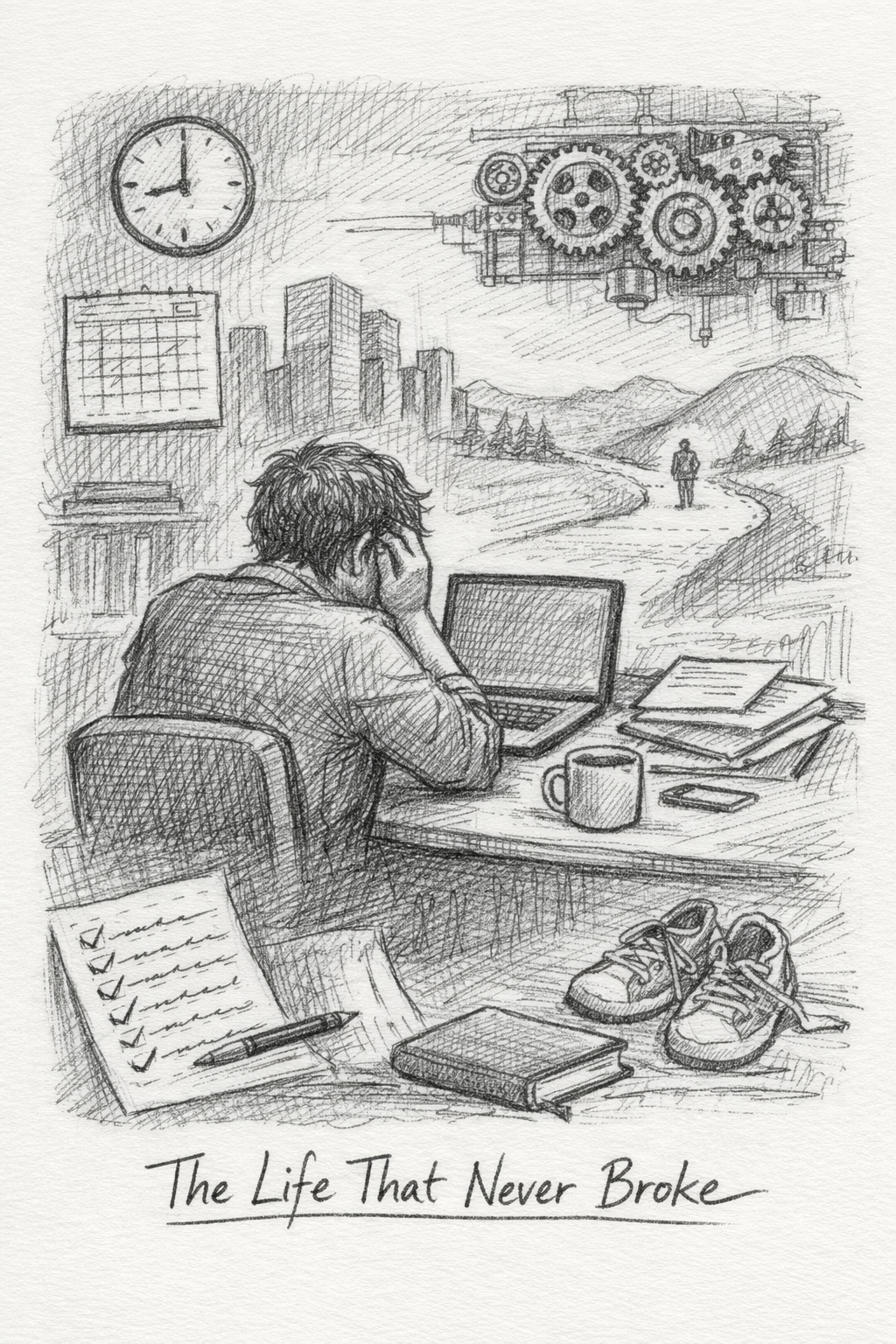
I figured out the problem on a day when nothing went wrong, and that’s what made it hard to argue with.
The work was done, the list was cleared, the room was quiet in that satisfied way that usually means you’ve earned rest, and yet I sat there longer than I needed to, staring at a closed laptop, feeling mildly irritated without a good reason to justify it.
The day had gone exactly as planned. Emails answered, tasks finished, progress made in the neat, measurable way that feels responsible.
At one point, I remember choosing not to step outside because there was one more thing I could wrap up quickly, and then another, and then the small, familiar relief that comes from an empty list. Nothing about that choice felt wrong. It felt efficient, which is why I had made it so many times before.
That’s how most of it happened. Not through big decisions or dramatic trade-offs, but through small, sensible ones that added up quietly.
I handled what had consequences and postponed what didn’t demand attention.
Rest could wait because nothing broke without it.
Curiosity could wait because it didn’t produce immediate returns.
Ease felt like something you earn after everything important is done.
Each choice made sense on its own, which is why none of them felt like a compromise while I was making them.
I’m good with systems, and systems are honest in a way people aren’t.
Calendars escalate. Deadlines punish.
Metrics respond when you act. You learn quickly what matters by watching what reacts.
Inner signals don’t behave like that.
They don’t interrupt meetings or impose penalties.
They wait patiently, and when you’re busy, patience looks a lot like irrelevance.
So I trusted what was loud and measurable and assumed that anything truly important would eventually force its way to the surface.
Most important things don’t. They sit quietly in the background, getting easier to ignore the longer everything else keeps working.
Over time, noticing turned into explaining.
Feeling tired became a scheduling issue. Feeling flat became something to optimize. A low, steady discomfort got translated into mood, timing, discipline, or not doing enough of the right habits.
The explanations were logical, which made them convincing, and they allowed me to keep moving without stopping long enough to ask what all this movement was actually for.
Nothing collapsed to force a pause.
Endurance started to feel like character.
Being low-maintenance looked like maturity.
Staying busy felt safer than slowing down, because slowing down would have meant sitting with questions that didn’t fit neatly into plans or metrics.
Avoidance didn’t look like avoidance when it produced results. It looked like responsibility.
The irritation I felt that afternoon wasn’t dramatic. It wasn’t sadness or panic or burnout. It was the quiet realization that I was very good at maintaining a life and less practiced at choosing it. The logic that had carried me this far still worked, but it started to sound thin, like advice I wouldn’t give someone younger than me because it would narrow them, or someone older than me because they’d already seen where it leads.
Nothing had failed. The system had done exactly what I trained it to do. And once I could see that clearly, it became hard to keep confusing a life that runs smoothly with a life that’s been lived deliberately.
That’s the trickiest part of growing up that no one really spells out. Sometimes the danger isn’t that things fall apart. It’s that they never do, and you wake up one ordinary day realizing the machine has been running beautifully while you’ve been standing just slightly to the side of it, calling that normal because it worked.
Leave a Reply