It didn’t feel important when it happened, which is probably why it stuck.
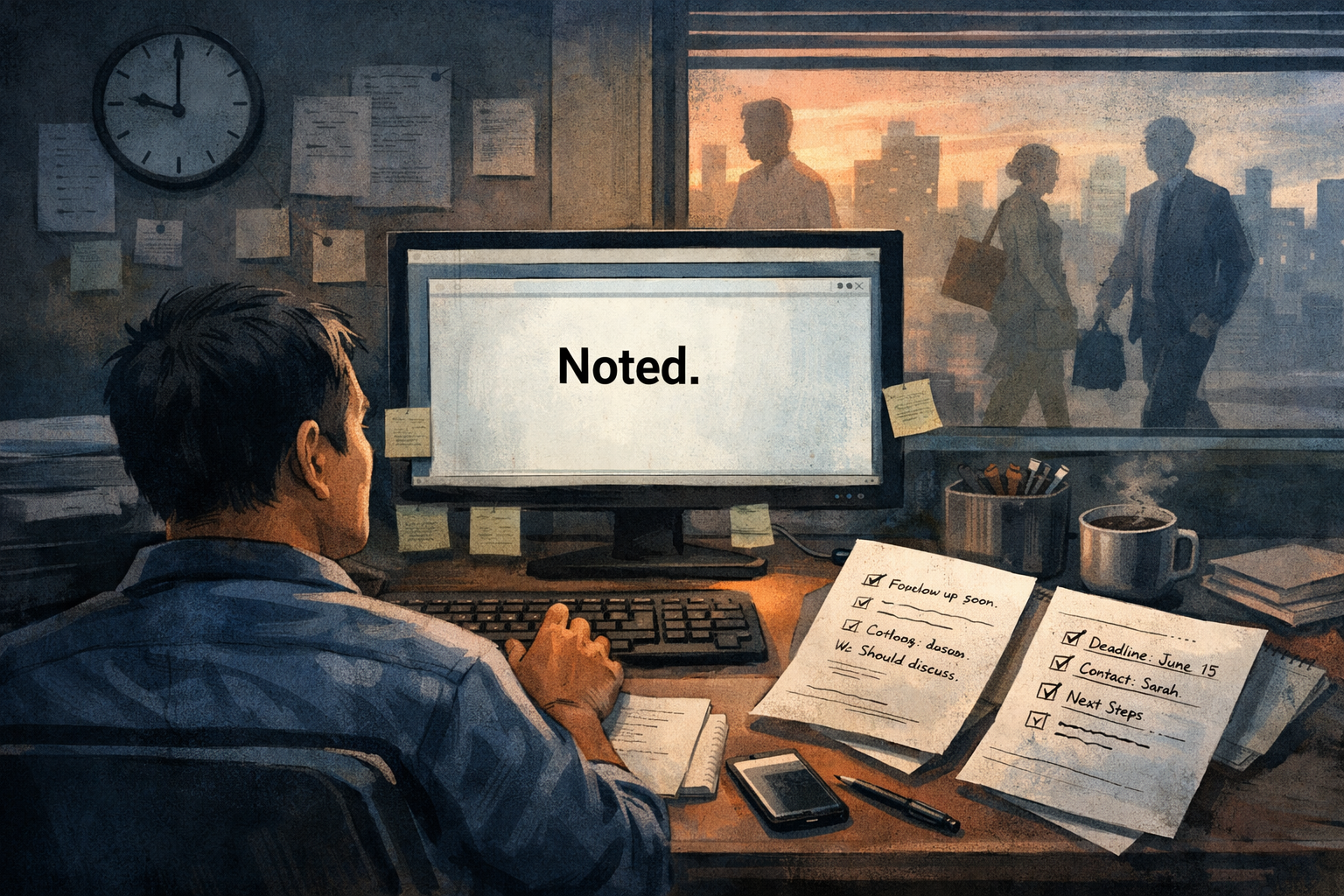
The reply came back with one word — “Noted” — and there was nothing behind it.
No relief. No tension. No urge to reread the sent message and wonder if it was too much.
That absence was the signal. Something that used to wobble had already stopped.
Earlier that morning, the meeting had gone the way most meetings go when everyone wants to be agreeable and leave on time. Heads nodded. Someone said, “Sounds good.” Someone else said, “We’ll come back to it.”
No one asked who would still be thinking about this a few weeks later, or how long “soon” could stretch before it quietly became never, or what would actually happen if attention drifted and didn’t return. Everyone packed up, satisfied in that familiar way that feels efficient but isn’t.
Later, alone, two drafts were open.
One was careful and friendly, written to keep things smooth and trust that people would remember what mattered when it mattered.
It left space everywhere — space for interpretation, space for priorities to change, space for no one to feel pinned down. It read well. It also avoided commitment so cleanly it was almost impressive.
The other draft wasn’t sharper. It was simpler.
Dates replaced “soon.” Names replaced “we.”
Near the end was a short sequence explaining what would happen if nothing moved.
No warnings. No urgency. Just the next step, written plainly.
That’s where everything slowed down. Not because it felt risky, but because it felt final.
Vagueness keeps relationships comfortable. Clarity makes things real.
Once that sequence existed, there would be no pretending later that no one saw the stall coming.
So the fear went somewhere else first. Onto a private page.
If this slows, then this happens. Call these people. Wait this long. Decide again.
Writing it out shrank it. The worst case stopped feeling heavy and started looking ordinary — awkward conversations, calendar changes, a few uncomfortable weeks. Annoying, not catastrophic.
It also didn’t feel new. The work behind that clarity had been stacking quietly for months.
Messages rewritten late so they wouldn’t cause problems later. Slides practiced until transitions didn’t need thought. Things checked twice because explaining a preventable mistake always costs more than preventing it.
From the outside, progress would later look sudden. From the inside, it had always looked slow.
The pressure hadn’t shown up all at once. It crept in through small permissions.
Skip this step. Rush that review. Just this once.
Each shortcut felt harmless, and each one made the next easier, while it took longer to recover every time.
Eventually the trade stopped working. Standards stopped bending. Shortcuts stopped feeling clever.
When things bent, they bent less. When they snapped back, they snapped back faster.
The same pattern showed up elsewhere.
People doing the heaviest lifting treated rest like a favor instead of something structural.
Weekends stayed flexible.
Sleep got traded for one more task.
At some point, flexibility turned into fixed blocks, and decisions got better without anyone working more, which felt strange after years of believing effort was the solution to everything.
The email went out. It landed. The reply came back. “Noted.”
Nothing resolved itself in that moment. Nothing broke either. But the next decision took less time, and the one after that took even less, because drift only survives when no one is willing to look straight at it.
The cursor stopped blinking. Another draft waited, and this one didn’t feel heavy.
Drift didn’t vanish. It just stopped being in charge.
Leave a Reply