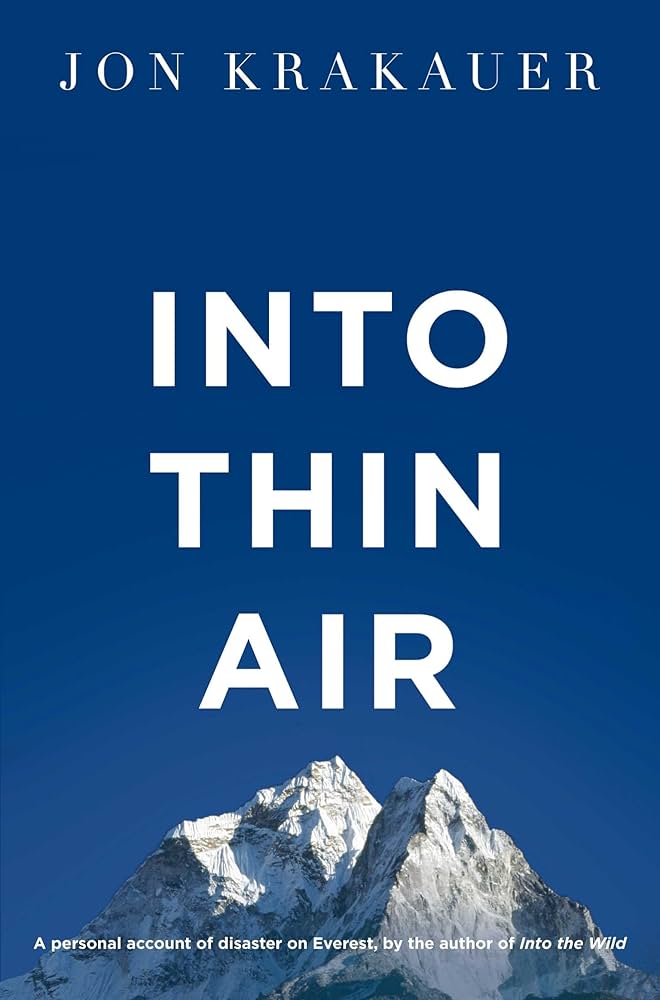
I picked up Into Thin Air a few years back because I wanted to understand something that didn’t make much sense to me.
Why would anyone choose to climb a mountain that kills so many people?
Everest especially.
There are hundreds of other peaks, safer, quieter, maybe just as beautiful, and I couldn’t figure out what people were chasing up there; I turned over the usual explanations—thrill, ego, some private calling—but none of them felt large enough to justify the risk, so I assumed the book would clear that up.
It didn’t.
A Small, Private Question That Got Too Close
The book found me at a time when I was already thinking about how people move toward certain things without ever announcing the movement to themselves, and I wasn’t searching for adventure stories so much as watching patterns—how a direction begins to feel natural long before anyone names it.
Krakauer doesn’t write like someone selling Everest or defending it; he writes like someone watching his own restlessness with a mix of honesty and restraint, aware that it has shaped his life without offering a neat explanation, and that tone strips spectacle away and leaves something quieter, more stubborn.
Learning Without Noticing
Most of the climbing language was unfamiliar at first—jumar, belay, crampon, piton—but the terms settle into the sentences without fuss, explained just enough and then allowed to work, so a few chapters in you discover you’re following along naturally and can’t recall the moment the vocabulary stopped being foreign.
Ordinary Lives, Slightly Reoriented
The climbers surprised me by feeling ordinary: regular jobs, families waiting at home, the same jokes and anxieties you hear elsewhere, which makes Everest less the province of an extreme personality and more the endpoint of a life that leaned a certain way over time.
That shift matters because it removes the comforting story that only a few rare people choose the mountain; it shows how a direction grows inside a life that otherwise looks familiar.
How the Idea Takes Root Early
For Krakauer, the notion of Everest lodges in childhood: he’s about nine when the 1963 American expedition returns, his father knows Willie Unsoeld, and climbing with Unsoeld’s kids makes Everest feel less like a distant fantasy and more like a plausible piece of a normal life—an ordinary influence that has staying power because it slips into routine rather than banging at the door.
The Long, Quiet Pull
Years later, that early exposure threads through his choices; in his twenties he buys a battered Pontiac Star Chief, drives west from Boulder, rides a salmon boat north and lives in a construction trailer where fish scales collect and maps take over every flat surface, and then the Devil’s Thumb becomes a lesson in modest persistence—one face pushes him back, another demands patience, ice undoes work, gloves stay damp, and little by little climbing occupies the spare hours and then the main ones.
Other parts of life don’t collapse so much as narrow: marriage moves toward steady routine, breakfasts keep happening, conversations skim the surface while attention slips elsewhere, and the everyday sequence of defensible small choices compounds into a direction that’s hard to reverse because it never looked unreasonable when taken step by step.
The Shape Repeats
Krakauer sees the same geometry in Into the Wild: McCandless’s bus becomes shelter then anchor, careful choices about food and routes compound into an outcome that happens incrementally and thus always seems sensible until it isn’t, and the unsettling lesson is that momentum often masquerades as conviction rather than error.
When the Mountain Stops Being Abstract
By 1996, when Krakauer is on Everest reporting on guided expeditions, base camp reads like a temporary town—tents close together, people trading small roles and routines, smoke from yak-dung fires sharp enough to sting your nose and oddly domestic in its persistence—religion and ritual fold into preparation, money and family and professional obligations bring practical reasons to keep going, and those practical reasons accumulate into a logic that makes sense to the people living it even while outsiders see risk.
Summit day then stretches that practical logic until it frays: turnaround times blur, bottlenecks form, storms tighten the schedule, and the weight of what has already been invested presses hard against caution; survival becomes a mix of endurance, timing, and luck built on choices whose shape was set long before the final push.
Where It Closes
Finishing the book left me thinking about how decisions compound: curiosity becomes habit, habit becomes calendar, the calendar writes a life that looks coherent from the inside because each step felt reasonable when it was taken.
A small, ordinary image kept returning to me—a backpack left by the door, half-packed from the weekend, one strap twisted the way it always twists—and that object felt less like clutter than confession; it holds the same motion as the mountain’s pull, and that is the subtle, stubborn lesson this story records.
You don’t choose the mountain at the end.
You choose it every day before you see it.
Leave a Reply