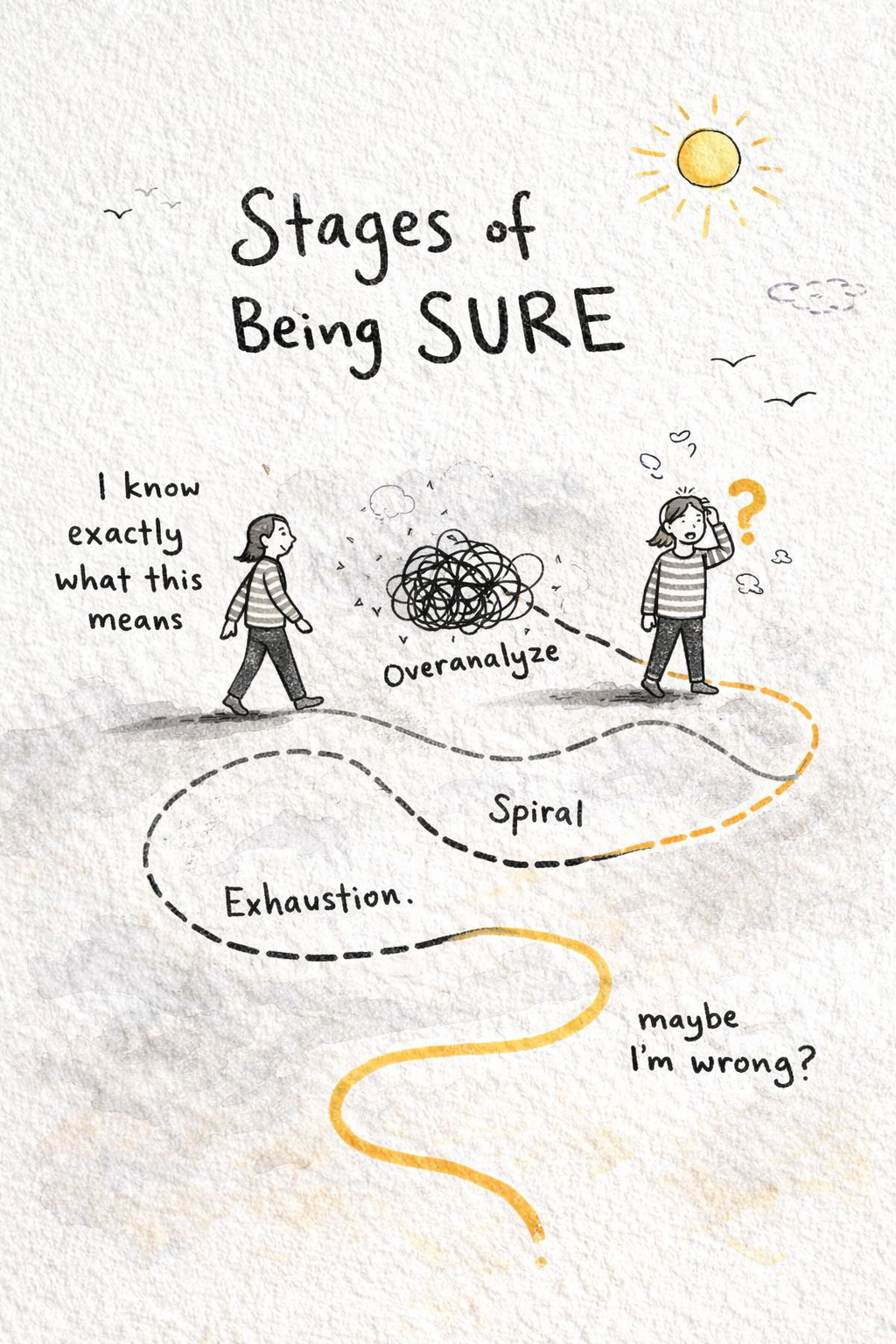
I’ve been thinking about how often I’m technically present and still not really there. The other night I was sitting with someone I care about, listening to them talk, and halfway through I realized I couldn’t repeat what they’d just said. I had drifted into my own head, replaying something small from earlier in the day and stretching it into a future that hadn’t happened. From the outside it probably looked like I was engaged. Inside, I was somewhere else entirely.
I keep telling myself I’m just distracted because life is busy, but that explanation feels too convenient. What’s closer to the truth is that I decide very quickly that I understand what’s happening. Once I think I know what something means, I stop paying close attention to it.
A slightly flat tone becomes proof of irritation. A delayed reply becomes distance. I fill in the gaps without even noticing that I’m doing it, and then I respond to the story I created instead of what’s actually in front of me.
It’s uncomfortable to admit how much confidence is wrapped up in that. Jumping to conclusions feels efficient. It feels smart. It gives me the illusion that I’m perceptive.
But most of the time I’m recycling old patterns. I’ve had enough experiences of rejection that my mind can now generate the entire script in seconds. The script feels familiar, and familiarity feels reliable, even when it’s outdated.
This shows up in how I’ve tried to move past hurt. For a long time I thought forgiveness was the goal. It sounded grown-up and emotionally evolved. You understand, you let go, you rise above it.
I could say I forgave someone and still find myself replaying the same conversations in my head. What actually shifted things wasn’t forgiveness. It was understanding in a much more ordinary sense.
When I could see why someone acted the way they did, even if I didn’t like it, the replay began to lose its grip. If I could recognize the insecurity behind the withdrawal or the fear behind the defensiveness, it stopped feeling like a personal attack and started feeling like a human reaction.
I didn’t have to approve of it. I didn’t have to welcome it back into my life. I just didn’t need to keep solving it. Once something made sense, my mind relaxed around it.
The harder version of that was looking at myself the same way. There are versions of me I’ve been embarrassed by, especially in relationships.
The one who held on too tightly, who explained herself too much, who tolerated situations that weren’t good for her. I’ve told a very neat story about that version: she lacked boundaries, she didn’t know better. It’s tidy and slightly cruel.
When I slow down, I can see she was trying to protect something. She was trying to avoid loss. She was doing the best she could with the awareness she had at the time. That doesn’t magically turn those choices into wise ones, but it does make them easier to look at without flinching.
I’m also rethinking what I thought confidence was supposed to look like. I’ve spent years trying to be certain about who I am and what things mean. There’s something reassuring about having a strong, fixed identity. It feels like standing on solid ground. Lately I’m starting to see how often that solidity becomes rigidity. When I decide I’m bad at confrontation, I stop noticing the moments I handle it well. When I decide someone is unreliable, I filter out the times they show up. The story becomes more important than the data.
Stress seems to work the same way. When I’m anxious, it’s rarely because something terrible is happening right now. It’s because I’m convinced something terrible is about to happen and I won’t handle it. My body reacts to that prediction as if it’s already real. If I question either half of that belief — maybe the outcome won’t be catastrophic, maybe I’m more capable than I think — the intensity eases a little. The situation hasn’t changed. My certainty has.
I don’t think the answer is to become endlessly positive or relaxed. That sounds fake even as I type it. What seems to matter more is leaving a small gap between what I assume and what is actually unfolding. When I notice myself thinking, this always happens, I try to check whether that’s actually true. When I’m sure I know what someone meant, I remind myself I could be wrong. That little bit of hesitation pulls me back into the moment.
Being here, really here, doesn’t feel spiritual or impressive. It feels more like catching myself in the act of narrating and deciding to look again. Sometimes I manage it, sometimes I don’t. But on the days I remember to question my own certainty, life feels less like a script I’m replaying and more like something that’s happening in real time.
Leave a Reply