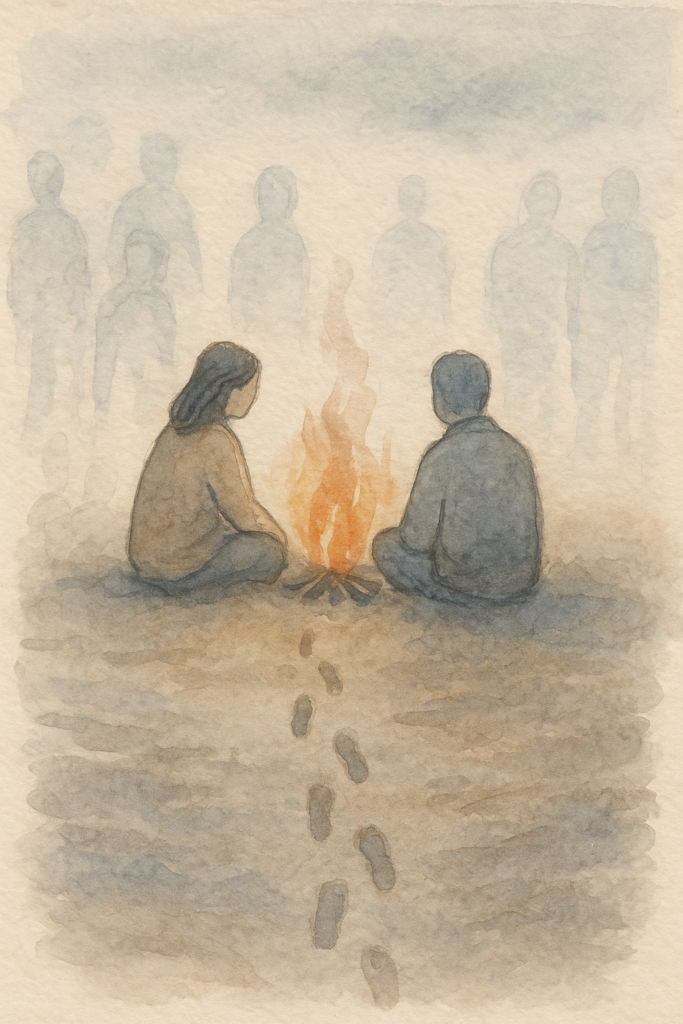
Choose the ones who stay through the cold.
There’s a quiet kind of grief that builds when you realize someone likes you just enough to keep you close, but not enough to let you in.
It doesn’t arrive dramatically. It drips. It seeps in slowly, washing away your clarity until you can no longer tell the difference between affection and ambivalence.
They don’t harm you outright. They just don’t feed you emotionally. And so you wither while convincing yourself that you’re full.
We are so skilled at rationalizing absence. Especially when the idea of someone—the version we’ve created in our minds—is easier to love than the person in front of us.
We tell ourselves they’re just scared, or overwhelmed, or healing.
We bend reality to protect a dream.
It’s not that we don’t know. It’s that knowing and leaving are entirely different battles.
Many of us get lost in that thin, aching space between almost and not quite.
We confuse effort with progress.
We wear patience like it’s proof of character.
We tell ourselves that love requires work—but forget that work must be mutual.
We call our silence maturity.
We call our emotional labor growth.
But often, it’s slow erosion in disguise.
They aren’t always careless. Sometimes they’re thoughtful.
Sometimes they remember the little things. That’s what traps you.
You collect those rare gestures like tokens to justify the emptiness in between.
If they aren’t cruel, maybe you’re just sensitive.
Maybe your needs are too much.
Maybe if you try harder, they’ll meet you there.
What we don’t often say aloud is that love exists on a spectrum. It’s not always nurturing or toxic.
Sometimes, it’s a quiet kind of neglect—a slow disconnection that nobody admits but everyone feels.
It’s not villainy. It’s two people, doing their best with limited tools, hurting each other by simply staying mismatched.
Attachment styles help explain what language we speak when it comes to love.
Anxious types perform.
We anticipate. We overextend.
We edit ourselves in real time.
We apologize for existing too loudly.
Love becomes an act of pleasing, hoping that safety will follow.
Avoidant types don’t always know they’re pulling away.
It’s not rejection—it’s protection.
Closeness feels like exposure.
Vulnerability is a threat to the stability they’ve carefully built.
They don’t disappear maliciously.
They hover. They breadcrumb.
They dip just enough to signal presence but stay far enough to avoid real intimacy.
And so begins the loop.
One person reaching. The other retreating.
One craves closeness. The other needs distance.
Both believing they’re doing the best they can.
Both slowly collapsing under unmet emotional needs.
I know the loop intimately. I stayed in it far too long, taking pride in being the one who held space, who waited patiently, who understood.
I called it strength. But it wasn’t strength.
It was hunger. It was self-abandonment dressed in devotion.
We’re taught to romanticize struggle.
We see pain as depth.
We think longing is proof of love.
We cling to the chaos and call it passion.
But the nervous system doesn’t lie. It tells us when something is unsafe. That pit in your stomach after being dismissed, the adrenaline spike when they finally respond—these are not signs of intimacy. These are signs of dysregulation.
There’s a way we rewrite our history to keep ourselves tethered to almosts.
We remember the good days. We glorify the connection.
We say, “But they loved me.” And maybe they did—in the only way they knew how.
But that doesn’t mean it was enough. That doesn’t mean it was right for you.
Love should not feel like rationing.
You shouldn’t have to dissect every interaction for clues of affection.
You shouldn’t have to keep proving your worth.
If love feels like a job interview, you’re not in a relationship—you’re in an audition.
Eventually, I stopped clinging to promises and started watching patterns.
I stopped waiting for someone’s potential to become who they already were not showing up as. I began asking:
Who are they when it’s inconvenient?
Who are they when I need softness instead of strength?
What I want now is simple:
Love that doesn’t make me question my needs.
Love that holds space when I falter.
Love that stays when it’s messy.
Love that listens even when it’s tired.
When someone asks you to wait while they figure it out, they are not preparing to love you better. They are protecting their own comfort.
If they make loving you feel like labor, that’s a door you need to walk away from.
You are not an audition.
You are not an afterthought.
You are not a second draft.
Write this down and don’t forget it:
“I deserve a love that does not need me to disappear in order to stay.”
Real love is steady. Not flashy.
It doesn’t arrive late and call itself fate.
It doesn’t leave you guessing.
It brings you back to yourself.
It reminds you of who you are—not because you forget, but because it insists you never settle for less than that again.
Leave a Reply