There’s an art to walking on eggshells. You learn it slowly—by bleeding. One wrong word, and the air shifts.
So you start rehearsing conversations before they happen.
You test your sentences like they’re loaded.
You speak in drafts.
You measure your tone.
You soften the truth until it’s unrecognizable—just to keep things from tipping over.
Not because you enjoy being the peacekeeper.
But because you know who’ll pay if it breaks.
They’ll shut down.
They’ll lash out.
They’ll go cold.
You? You’ll stay up at 3 a.m., replaying it all like a detective at a crime scene. Wondering if your honesty was too much.
Wondering if your needs were too loud.
Wondering if you could’ve just said it better, maybe they wouldn’t have left you holding the pieces again.
And somehow, you still end up the one saying sorry.
It’s easy to think you’re being kind. That choosing your words carefully is mature. Empathetic. Grown-up. But what if it’s just survival? What if it’s just a strategy you learned because they never learned how to take care of your heart the way you try to take care of theirs?
Because while you’re playing translator, they’re throwing tantrums in their native tongue.
While you’re managing tone, they’re managing to say whatever they want—without flinching.
And if you push back?
You’re too sensitive. You’re dramatic. You’re difficult. You’re the problem.
So you keep folding yourself smaller. Make it easier for them to stay. Easier for them to not grow.
You keep the peace even when it costs your sanity, because some twisted part of you still believes that if you don’t, the whole thing will collapse—and when it does, it won’t be them who suffers. It’ll be you.
Because they move on. They compartmentalize. They sleep. You stay up.
People love to tell you to “set boundaries.” Like it’s a line you draw and everyone suddenly gets polite and respectful. But when you’re dealing with someone who resents accountability, boundaries feel like lighting a match in a room soaked with gasoline. You say what you need, and suddenly you’re the danger.
But here’s what’s slowly, painfully becoming clear: protecting a connection where only one person’s feelings matter isn’t noble. It’s self-abandonment.
And I’ve done enough of that.
I’m not interested in playing the only adult in the relationship.
I’m not doing the emotional labor for two.
I’m not carrying both our fears while you carry none of our growth.
I want what I give.
I want someone who doesn’t treat my honesty like a threat.
Who doesn’t require me to pre-digest every sentence.
Who meets me halfway—not because I demand it, but because they want to.
Because love isn’t peacekeeping.
It’s truth-telling.
It’s staying when it’s hard, not disappearing the second it gets uncomfortable.
It’s owning your own impact and still being safe for someone else.
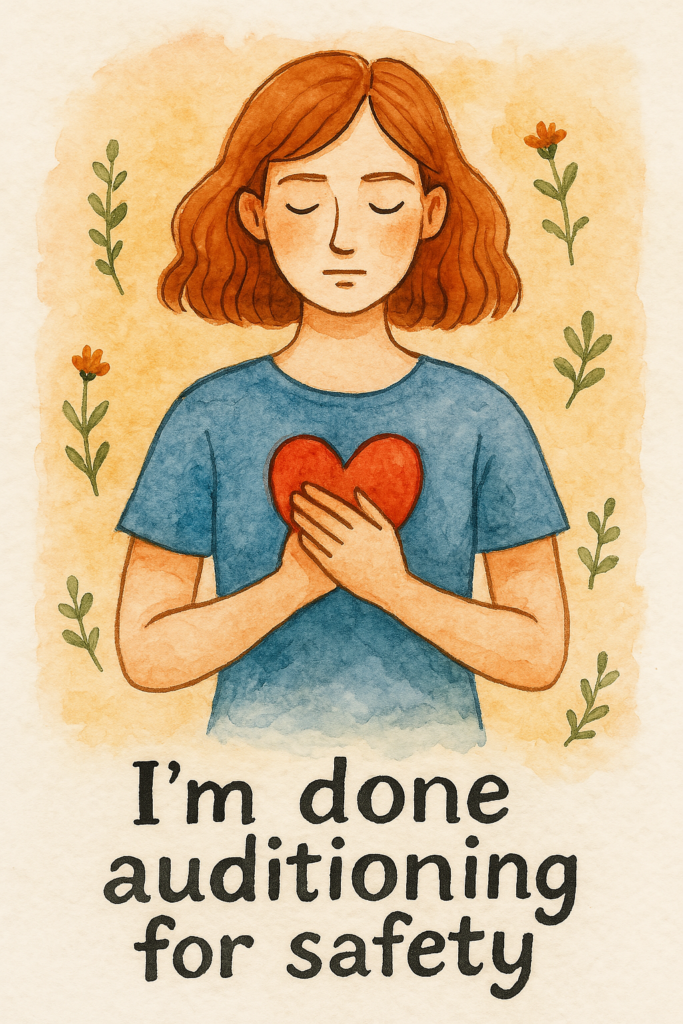
If it only works when I’m bending, filtering, dimming—that’s not love. That’s performance. And I’m done auditioning for safety.
Leave a Reply